














Rare Cloud Formation Seen from Space

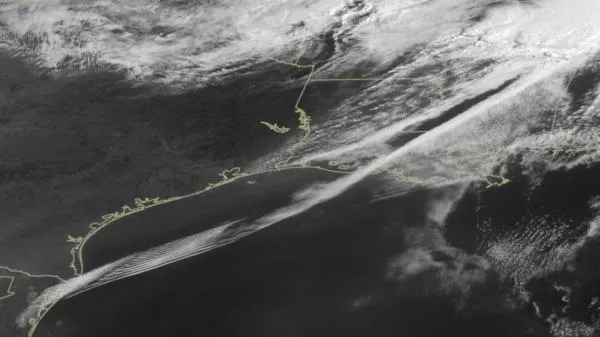
A rare cloud formation was caught by a satellite as it rolled across the Gulf of Mexico on April 27.
The formation is called an undular bore, or gravity wave train, and it appears as rarely as once a month. An undular bore is a disturbance in the Earth's atmosphere that can be seen as clouds move in waves. They normally occur within an area of the atmosphere that is stable in the low levels after a cold front moves through.
Undular bores are usually formed when two air masses of different temperatures collide. When a low-level boundary such as a cold front approaches a layer of cold, stable air, it creates a disturbance in the atmosphere producing a wave-like motion, known as a gravity wave.
The undular bore waves appear as bands of clouds across the sky. They are shaped by gravity and propelled by the transfer of energy from an oncoming storm. The ripple-like appearance of this wave is much similar to what happens when a pebble is dropped into a pond or when a moving boat creates waves in the surrounding water.
In water, the pebble or boat displaces the water that the wave is traveling through and the water moves in an upward motion. However, because of gravity, the water is pulled back down and the repetition of this cycle creates the wave motion. The same thing happens with undular bores in the atmosphere.
An undular bore can stretch 5 miles (8 kilometers) between peaks and can travel at speeds of between 10 and 59 mph (16 and 95 kph).
Undular bores are believed to be catalysts for thunderstorms . Although a thunderstorm helps create an undular bore, an undular bore can in turn intensify a thunderstorm because it further disturbs the atmosphere.
Get the world’s most fascinating discoveries delivered straight to your inbox.
- Gallery: Reading the Clouds
- Infographic: Earth's Atmosphere Top to Bottom
- The World's Weirdest Weather
