














Ways to Save a Rare, Tropical Bird

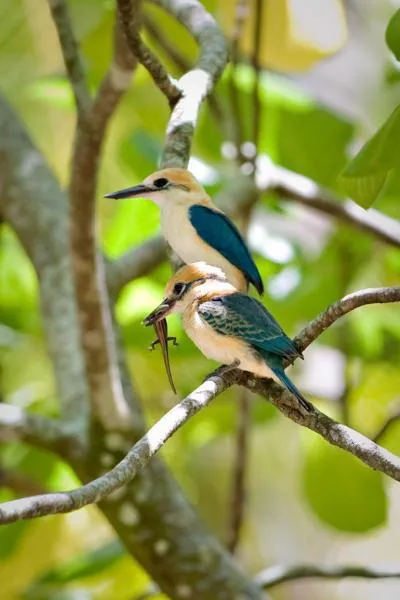
The Tuamotu Kingfisher is a multicolored, tropical bird with bright blue feathers, a dusty orange head, and a bright green back.
The entire population of these birds less than 125 lives on one tiny island in the South Pacific, and without serious intervention, they will no longer exist, scientists say.
One researcher is trying to stop the birds' extinction by working with farmers and residents on the island inhabited by the kingfishers.
"If we lose these birds, we lose 50,000 years of uniqueness and evolution," said Dylan Kesler, assistant professor in fisheries and wildlife at the University of Missouri's School of Natural Resources in the College of Agriculture, Food and Natural Resources. "Because it has lived in isolation for a very long time, it's unlike any other bird. There is no other bird like this on the planet."
Kesler and his colleagues have found a unique way to attach radio transmitters to the birds to track them and have discovered things about the birds, and ways that farmers can help, that could improve the birds' chances of survival.
To survive, the kingfishers need several specific habitat characteristics:
- Hunting perches that are about 5 feet off the ground - The birds hunt by watching their prey from the perches in broad-leaf trees and then "pouncing" on them.
- Exposed ground - The birds' food consists mainly of lizards, which are easier to spot where the ground is clear of vegetation. When coconut farmers conduct intermediate burns on their land which are hot enough to kill brush, but do not lead to widespread fires or kill the lizards it exposes more ground and the birds can see the lizards.
- Dead trees for nesting - The birds create nests by flying into dead trees and hollowing cavities. Live trees are too hard and many farmers cut down their dead coconut trees. By encouraging farmers to leave some dead trees, the birds will continue to be able to build nests.
- Fewer predators - Cats and rats, which were introduced to the island by humans , now hunt the Tuamotu Kingfisher. By wrapping metal bands around the trees, Kesler found that the predators are less likely to get into the nests, but he is still searching for other solutions that might alleviate the pressure on the birds.
- Birding for Beginners: A Novice Gets Tips from the Pros
- Oldest Known Wild Bird Survives Japan Tsunami
Get the world’s most fascinating discoveries delivered straight to your inbox.
