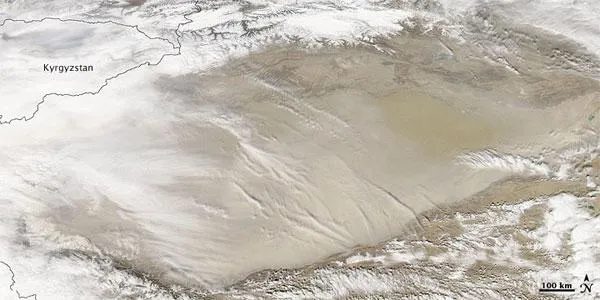
Dust Storm Blows over Taklimakan Desert
Get the world’s most fascinating discoveries delivered straight to your inbox.
You are now subscribed
Your newsletter sign-up was successful
Want to add more newsletters?
Delivered Daily
Daily Newsletter
Sign up for the latest discoveries, groundbreaking research and fascinating breakthroughs that impact you and the wider world direct to your inbox.
Once a week
Life's Little Mysteries
Feed your curiosity with an exclusive mystery every week, solved with science and delivered direct to your inbox before it's seen anywhere else.
Once a week
How It Works
Sign up to our free science & technology newsletter for your weekly fix of fascinating articles, quick quizzes, amazing images, and more
Delivered daily
Space.com Newsletter
Breaking space news, the latest updates on rocket launches, skywatching events and more!
Once a month
Watch This Space
Sign up to our monthly entertainment newsletter to keep up with all our coverage of the latest sci-fi and space movies, tv shows, games and books.
Once a week
Night Sky This Week
Discover this week's must-see night sky events, moon phases, and stunning astrophotos. Sign up for our skywatching newsletter and explore the universe with us!
Join the club
Get full access to premium articles, exclusive features and a growing list of member rewards.
NASA's Aqua satellite today (March 2) captured this image of dust stirring over the Taklimakan Desert.
Along the southern rim of the Tarim Basin, which the Taklimakan Desert fills, thick dust completely obscures the desert floor.
Clouds hover over the dust, some of them casting shadows onto the sea of tan and beige below. Along the northern edge of the desert, skies appear clearer.
Situated between the mountain ranges of the Tien Shan (or Tian Shan) in the north, and the Kunlun Shan in the south, the Taklimakan Desert is China's biggest, hottest, driest desert , according to a NASA statement.
Isolated from the effects of the Asian monsoon and Arctic storms , the desert receives little water. Lacking drainage for the water it does receive, the desert has accumulated large quantities of salt.
Most of the Taklimakan is covered by mobile sand dunes.
Get the world’s most fascinating discoveries delivered straight to your inbox.