













Dinosaur Graveyard Yields Fossil Bounty
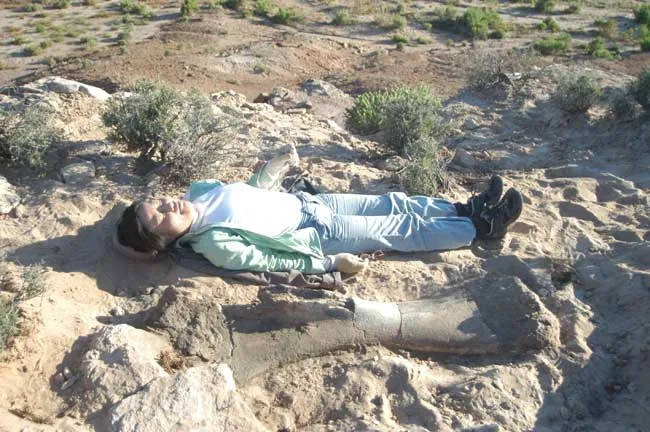
A "dinosaur graveyard" full of fossils has been discovered in a former river bed in Utah, presenting an opportunity for a decade's worth of Jurassic research by paleontologists, it was announced this week. Scientists and technicians with the Utah Thornbury Dinosaur Expedition unearthed an abundance of sauropod (an herbivorous long-necked dinosaur) finds, as well as the bones of several carnivorous dinosaurs, said paleontologist Luis Chiappe, director of the Natural History Museum of Los Angeles County’s Dinosaur Institute. Nearby, the team, led by the museum, also discovered a 5-foot humerus (arm) bone from a brachiosaur, a gigantic long-necked dinosaur. The graveyard’s star discovery thus far is "Gnatalie," a well-preserved skeleton of a 150 million-year-old sauropod. Tracks of Jurassic Period sauropods at the site in San Juan County were found near tracks of carnivorous theropods and herbivorous ornithopods of the early Cretaceous. And, even more notably, the sandstone site also features tracks belonging to a European stegosaur, named Deltapodus, Chiappe said. “The Deltapodus tracks have never been found in North America,” Chiappe said. “When we began the process of collecting specimens from the Utah Thornbury Dinosaur Expedition, we had no clue about the association of Jurassic and Cretaceous footprints.” The discovery of these track ways is part of an international effort to track the migration patterns of dinosaurs following the split of Pangea, a supercontinent that existed during the Paleozoic and Mesozoic eras, during the Jurassic. "Paradoxically, the late Jurassic dinosaurs from western-most Europe appear to be more similar to those in North America than to those in the rest of Europe,” Chiappe said, “and the Utah Thornbury Dinosaur Expedition project helps us to put together an important piece of the puzzle.” Major findings from the expedition will be featured in the museum’s newly renovated dinosaur galleries, set to open in 2011. The museum has one of the largest collections of dinosaur and Mesozoic fossils in the world.
- Video: Finding the 'Leonardo' Fossil
- Gallery: Dinosaur Fossils
- A Brief History of Dinosaurs
Get the world’s most fascinating discoveries delivered straight to your inbox.