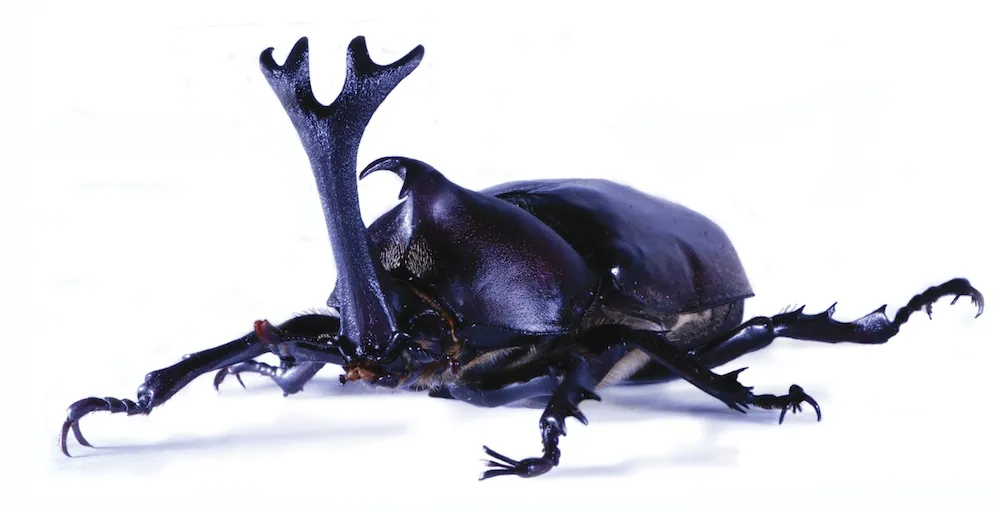
Sporting a horn on your head two-thirds the length of your body might seem like a drag. For the rhinoceros beetle, though, massive head-weapons are no big deal.
Turns out, pitchfork-shaped protrusions on the heads of rhinoceros beetles don't slow them down during flight, new research shows. The findings may explain why the beetles' horns are so diverse and elaborate, said study researcher Erin McCullough, a doctoral student at the University of Montana.
"Because the horns don't impair the beetles' ability to fly, they might be unconstrained by natural selection," McCullough told LiveScience, referring to the evolutionary process that weeds out weak traits while passing on advantageous ones.
The finding would clear up a rhinoceros beetle mystery. Male rhinoceros beetles (there are more than 300 species) are known for their huge horns, some of which can exceed the length of the rest of the beetle's body. The males use these horns, which come in an array of shapes, to battle each other for supremacy of sap-leaking sites on trees. Females are drawn to these sites to feed, and males perched there are more successful at mating with those females. [Images: Amazing Rhinoceros Beetles]
"Rhinoceros beetles are just fantastic creatures," McCullough said. "They have the most elaborate weapons that we find really in almost any animal."
Two male rhinoceros beetles lock horns in battle.
(Image credit: Douglas Emlen)
McCullough and her colleagues expected those weapons came at a cost. Flashy body parts often do; in fact, scientists theorize that wild feathers or other elaborate mate-attracting devices send a signal that says, "Mate with me! I'm so healthy I can support a totally useless appendage!"
Sign up for the Live Science daily newsletter now
Get the world’s most fascinating discoveries delivered straight to your inbox.
To evaluate the cost of the beetles' horns, McCullough tested Asian rhinoceros beetles (Trypoxlus dichotomus), which have horns about two-thirds as long as their bodies. After euthanizing the beetles, she weighed them with and without their horns. She also determined the center of mass of the beetles with and without their horns. Finally, she tested the beetle bodies in a wind tunnel to see how the horns affected the drag on the beetles' bodies and thus the force they'd need for flight.
Beetle surprise
What she found surprised her. The beetle horns weren't a drag at all.
The horns turned out to be very dry and hollow, McCullough said. They comprised only 0.5 percent to 2.5 percent of body weight. Because of their low mass, they hardly affected the beetles' center of mass. Cutting off a male's horn moved his center of mass only about 1.7 percent.
And in flight, the horns made no difference at all. The beetles fly slowly with their bodies in a near-vertical position, McCullough found. At this angle, even a huge horn adds almost no drag. The researchers report their findings today (March 12) in the journal Proceedings of the Royal Society B.
"This is not what I was expecting, but it's actually a nice simple explanation for my big interest in why we see so much diversity in these horns," McCullough said. Without much of a cost to the beetle's survival, evolution is essentially free to experiment with weird and wild horn shapes.
"There's a big benefit to having these horns, but I haven't found any evidence for any cost," she said.
Stephanie Pappas is a contributing writer for Live Science, covering topics ranging from geoscience to archaeology to the human brain and behavior. She was previously a senior writer for Live Science but is now a freelancer based in Denver, Colorado, and regularly contributes to Scientific American and The Monitor, the monthly magazine of the American Psychological Association. Stephanie received a bachelor's degree in psychology from the University of South Carolina and a graduate certificate in science communication from the University of California, Santa Cruz.