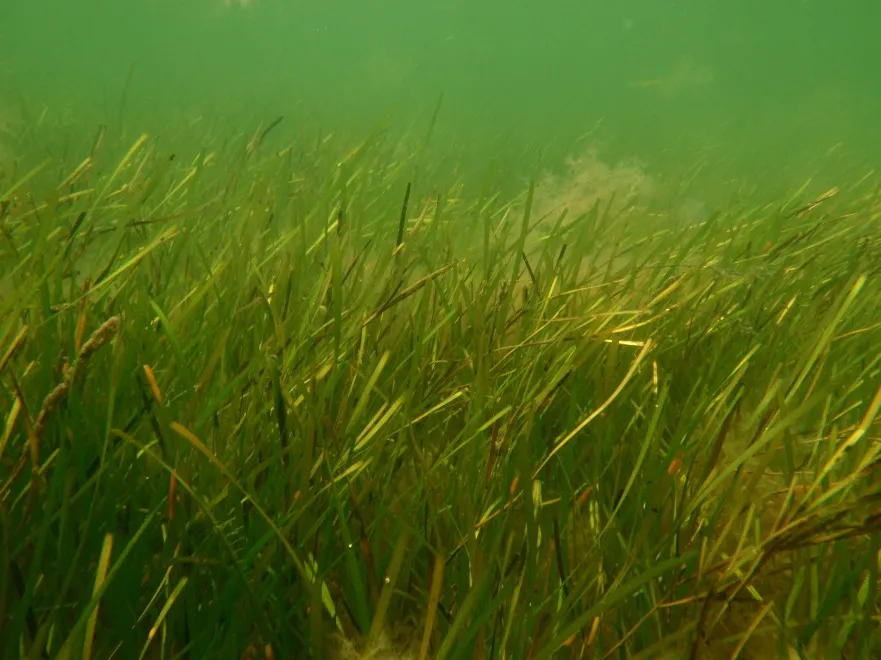
To spread and regenerate, an important marine plant depends on animals to eat its seeds and poop them out around the ocean, according to recent research.
Seeds from eelgrass, a type of marine grass found around the world, can survive and germinate after being eaten by three types of fish, one turtle and one type of bird, said Sarah Sumoski, a researcher at the Virginia Institute of Marine Science and co-author of a study published recently in the journal Marine Ecology Progress Series.
It's hard to understate the importance of eelgrass and other seagrasses, which globally can store up to twice as much carbon as the world's temperate and tropical forests, according to a separate study. This is potentially important as humans pump more carbon dioxide into the atmosphere. Eelgrass meadows, which grow on the ocean floor in shallow waters, also help shelter many different types of fish and crabs, and serve as food for animals as diverse as manatees and ducks, Sumoski told OurAmazingPlanet.
By hitching a ride in these animals' digestive tracts, the grasses' seeds can travel long distances, establishing far-flung seagrass meadows. Sumoski's study found that a type of diving duck called the lesser scaup can transport seeds more than 12 miles (19.5 kilometers); after this journey, the seeds can still sprout, Sumoski said.
This is the first study to show how these seeds fare when eaten by multiple types of animals, said Sumoski. The ability of some of the seeds to sprout after being eaten surprised Sumoski, she said, especially in the case of one fish species, which commonly feed on the grasses and are well equipped to break down plant material.
The study's results will help Sumoski and co-author Robert Orth in their efforts to reintroduce eelgrass to Virginia's coastal bays. In the 1930s, an outbreak of wasting disease and an enormous hurricane virtually wiped out these eelgrass beds, which provide a bedrock for marine life. The environmental impact was so great that bay scallops (a type of shellfish) disappeared; until that time the scallops had supported a significant local fishery.
For the last 15 years, Orth and a large group of collaborators have planted eelgrass shoots and millions of seeds throughout the coastal bays. Now, more than 6.6 square miles (17 square km) of lush eelgrass meadows line these bays, according to a release from the Virginia Institute of Marine Science. The researchers think the fish and other creatures have already helped spread the grasses beyond the areas planted by conservationists. Scientists hope that the animals will continue to spread the meadows in the future.
Sign up for the Live Science daily newsletter now
Get the world’s most fascinating discoveries delivered straight to your inbox.
"Animals consuming seeds in one location and then excreting them in another location where they can germinate is not new," said Matt Harwell, a seagrass ecologist who was not involved in the study. "However, it is a new finding for a seagrass species that is found across much of the world. Understanding population dynamics is very important to understanding the health, longevity, and resilience of a seagrass meadow to stresses, especially since recent estimates suggest that seagrass loss — globally — is around 7 percent per year."
Douglas Main loves the weird and wonderful world of science, digging into amazing Planet Earth discoveries and wacky animal findings (from marsupials mating themselves to death to zombie worms to tear-drinking butterflies) for Live Science. Follow Doug on Google+.