















Huge Sharks 'Fly' Like Fighter Pilots

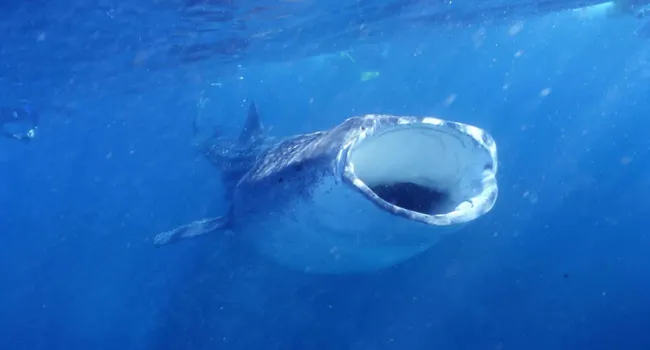
Monster sharks can execute underwater "flight" moves that would have put some fighter pilots to shame, two researchers announced this week.
Normally seen cruising slowly at the surface, the whale shark, which does not harm humans, can transform in the deep, hurling itself into a swift, steep dive like a pilot, soaring up and then down again in a series of great bounds, said researcher Rory Wilson of Swansea University in the Wales.
Whale sharks are the world's biggest fish. They are not whales or mammals.
“It is like the way a bird dives, then soars, using its momentum and gravity to conserve as much energy as possible. It flies like a bird — but in this case, a bird as large as a bus!” Wilson said. Such behavior has never been observed in a fish before, he said.
Wilson worked with Brad Norman of Australia's Murdoch University to track whale sharks in the Indian Ocean, off Ningaloo, on Australia's western coast. The team equipped several whale sharks with an electronic device that records in minute detail — eight times a second — the giant creature's every action, including speed, depth, pitch, roll and heading, along with every beat of the fish's tail.
"For the first time, we have an insight into what it is that these magnificent creatures get up to when they are out of sight of humans — and it isn't what we expected," said Norman, who received a Rolex Award in 2006 for his project employing "citizen scientists" worldwide to help study and protect whale sharks through an online global photo ID library.
"It's a real Jekyll-and-Hyde existence," said Wilson of the contrasting behaviors of the sharks revealed by his electronic wildlife monitor. The device is helping to reveal details of the lives of more than 50 animal species in the wild, a project that won Wilson a Rolex Award, also in 2006.
Get the world’s most fascinating discoveries delivered straight to your inbox.
The devices were attached in late May to eight sharks up to 26 feet (8 meters) long off Ningaloo. The devices are designed to release from the sharks and can be recovered by tracking them. The recovered data documented every move of the giant fish over several hours.
Eventually, the devices could reveal how and where whale sharks feed and breed, enabling those localities to protect the giant fish from human impacts such as hunting or pollution.
- Video: Whale Sharks Thriving
- Quiz: Shark Jobs, Nature's Dirty Work
- Sharks Everywhere: Vote for Your Favorite Shark
