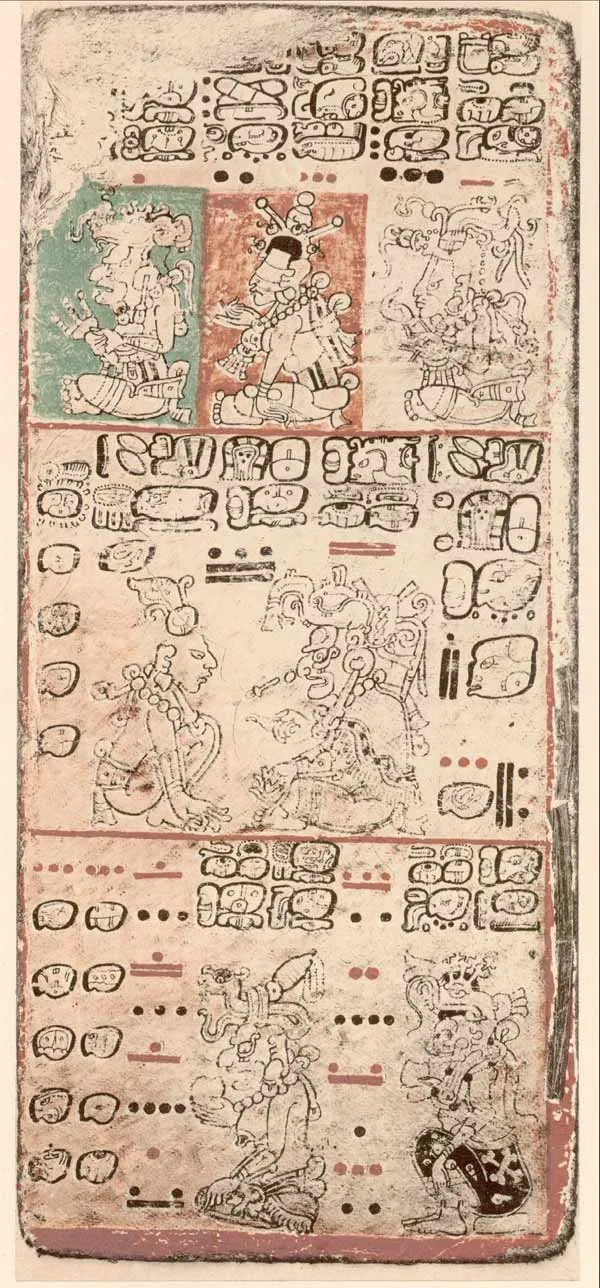
Anthropologists decoded early Mayan hieroglyphics from four codices, finding the Maya accurately predicted modern-day astronomical phenomena. Shown here, an image from the so-called Dresden Codex.
LONG BEACH, Calif. — The Maya, best known these days for the doomsday they never foretold, may have accurately predicted astronomical phenomena centuries ahead of time, scientists find.
A new book, "Astronomy in the Maya Codices" (American Philosophical Society, 2011), which was awarded the Osterbrock Book Prize for historical astronomy here at the American Astronomical Society conference Monday (Jan. 7), details a series of impressive observations made by Mayan astronomers pre-16th century.
Anthropologist husband-wife team, Harvey and Victoria Bricker have devoted their lives to understanding the pre-Columbian Maya and how they understood the world around them. The Brickers conducted most of their work by translating complex hieroglyphics to see what Mayan scribes felt was most important to record on parchment.
By decoding early Mayan hieroglyphics from four different codices housed in Madrid, Paris, Mexico and Dresden, the Brickers tracked how the night sky would have looked to the Mayans when they were alive.
"We're dealing with real data," Harvey Bricker said. "They're not just squiggles."
The Brickers translated the dates cited in the Mayan calendar to correspond with our calendar and then used modern knowledge of planetary orbits and cycles to line up the Maya's data with ours. It was surprisingly accurate. [Image Gallery: Amazing Mayan Calendar Carvings]
In fact, the Brickers found the astronomical calendar dated to the 11th or 12th century accurately predicted a solar eclipse to within a day in 1991, centuries after the Mayan civilization had ended. The 1991 eclipse occurred on July 11.
Sign up for the Live Science daily newsletter now
Get the world’s most fascinating discoveries delivered straight to your inbox.
Shown here, the path of the total eclipse that occurred on July 11, 1991.
(Image credit: NASA)
The team also found that the Maya had a fair number of superstitions surrounding observable heavenly bodies in the night sky. On the friendly side, they had the sun and the moon — a god and goddess, respectively — whose cycles were easy to map, predict and keep track of. In the not-so-friendly camp were Venus and Mars. The motions of those two planets usually signaled doom and destruction depending upon their place in the sky, the Brickers found.
The manuscripts warned that if Venus shines upon children, old men and women or healthy young men at certain points in its orbit, then harm would come to them. Because the Maya wanted to make sure these potentially dangerous moments didn't interfere with the lives of their people, Harvey Bricker said, they kept extremely detailed records of where Venus and other planets appeared in the night sky on certain days.
Mars — an animalistic god — signified gloomy days to come for everybody.
"There was thought to be a relationship, and not a happy one, between phenomena associated with Mars and agriculture," Harvey Bricker said.
Miriam Kramer joined Space.com as a staff writer in December 2012. Since then, she has floated in weightlessness on a zero-gravity flight, felt the pull of 4-Gs in a trainer aircraft and watched rockets soar into space from Florida and Virginia. She also serves as Space.com's lead space entertainment reporter, and enjoys all aspects of space news, astronomy and commercial spaceflight. Miriam has also presented space stories during live interviews with Fox News and other TV and radio outlets. She originally hails from Knoxville, Tennessee where she and her family would take trips to dark spots on the outskirts of town to watch meteor showers every year. She loves to travel and one day hopes to see the northern lights in person.