














Historic Camp Site Discovered on Antarctica

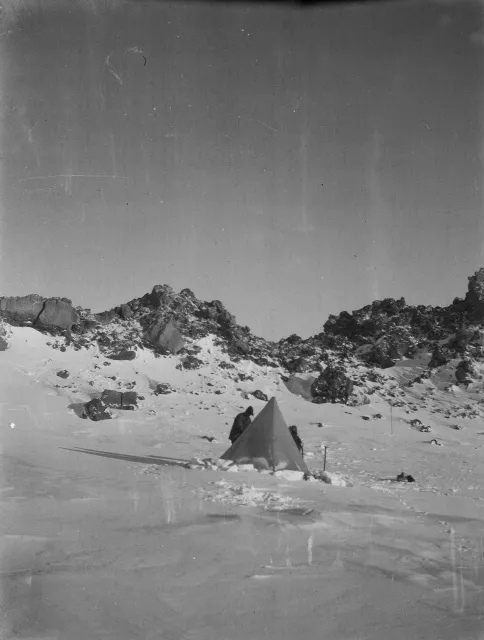
More than 100 years after two groups of men raced each other to be the first to reach the South Pole, modern-day explorers have re-discovered what appears to be one of their camp sites on the slopes of the world's southernmost volcano.
Norwegian Roald Amundsen and Englishman Robert Falcon Scott were the explorers who led teams of their countrymen on grueling journeys across the frigid continent in an effort to be the first to go where no man had gone before. Amundsen won the race, reaching the pole on Dec. 14, 1911. Scott also made it there, on Jan. 17, 1912, but perished with the remainder of his crew on the arduous trek back to the edge of the continent.
Scott and his team camped on the slopes of Mount Erebus, the southernmost volcano, during their journey. The spot was known as "the highest camp," according to a National Science Foundation release.
Clive Oppenheimer, a volcanologist at Cambridge University in England and working at Erebus as part of an NSF team, found what he thinks is the same camp site using written accounts and historic images from the Scott Polar Research Institute in Great Britain, the NSF release said. (The institute was founded by one of the men from Scott's party who climbed Erebus as part of the 1912 Terra Nova expedition.)
The site Oppenheimer located features a ring of stones where a tent once stood and appears to match historic photos taken during the 1912 expedition. "Conservators from the New Zealand-based Antarctic Heritage Trust have been asked to verify the historic find," the NSF wrote.
The area will be recorded and searched to look for artifacts from the original expedition. Tents and other sites from early 20th century expeditions have also been found and preserved, some with a wealth of artifacts.
The team that climbed Mount Erebus in 1912 included geologist Raymond Priestley; they took geological specimens and mapped the area. Scott's expedition was more focused on gleaning scientific research from their mission than Amundsen's was.
Get the world’s most fascinating discoveries delivered straight to your inbox.
The 1912 expedition was preceded at Erebus by the 1907-1909 Nimrod Expedition, mounted by explorer Ernest Shackleton, which failed to reach the South Pole.
The NSF team is studying the 14,500-foot Erebus, which is interesting geologically beyond being the southernmost volcano. It is also home to Earth's only long-lived lava lakes.
Editor's note: This story was updated to correct the date that Roald Amundsen arrived at the South Pole, which was in 1911, not 2011.
This story was provided by OurAmazingPlanet, a sister site to LiveScience. Reach Andrea Thompson at [email protected] and follow her on twitter @AndreaTOAP. Follow OurAmazingPlanet on Twitter @OAPlanet. We're also on Facebook and Google+.

Andrea Thompson is an associate editor at Scientific American, where she covers sustainability, energy and the environment. Prior to that, she was a senior writer covering climate science at Climate Central and a reporter and editor at Live Science, where she primarily covered Earth science and the environment. She holds a graduate degree in science health and environmental reporting from New York University, as well as a bachelor of science and and masters of science in atmospheric chemistry from the Georgia Institute of Technology.