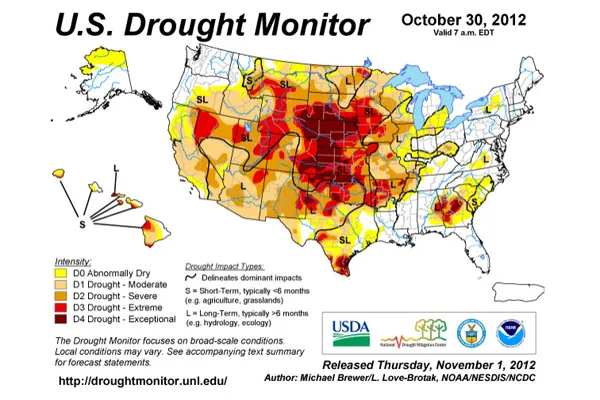
The U.S. Drought Monitor is produced in partnership between the National Drought Mitigation Center at the University of Nebraska-Lincoln, the United States Department of Agriculture, and the National Oceanic and Atmospheric Administration.
The dramatic inundation and devastation caused by Hurricane Sandy are getting the headlines, but a slow motion drought disaster still parches much of the United States.
The National Oceanic and Atmospheric Administration’s (NOAA) most recent map (above), released today, shows that moderate to extreme drought still holds sway over much of the Central and Southern U.S.
A recent NOAA report, released in October, stated that approximately 52 percent of the contiguous U.S. fell into the moderate to extreme drought categories of the Palmer Drought Index, a formula used to measure temperature and rainfall interactions.
As of the end of September, 37 percent of the contiguous U.S. suffered severe to extreme drought conditions.
Most recent topsoil moisture map.
(Image credit: USDA.)
These most recent figures set another record high in the 12-year history of the U.S. Drought Monitor. At some point in 2012, almost every county in the U.S. was declared an agricultural disaster area, by the U.S. Department of Agriculture (USDA).
Get the world’s most fascinating discoveries delivered straight to your inbox.
The farmer’s frustrations may continue into next year, unless a very wet winter restores soil moisture. Currently, soil moisture is very low and will make it difficult for crops like winter wheat to survive until next spring. Seventy-one percent of winter wheat fields are in drought conditions, according to the USDA. When spring does arrive, farmers will have to worry that they are planting corn and soy into soils still parched from this year’s monster drought.
Lower agricultural productivity in the U.S. may cause an increase in global food prices as ingredients become scarce.