













Road Kill: Too Many Frogs Croak

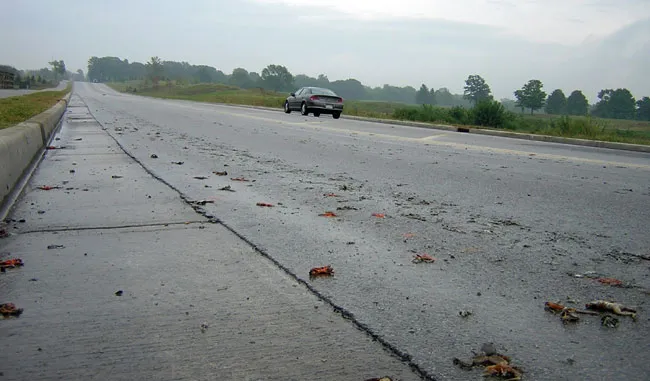
Ribbit, ribbit, ribbit, croak. Dozens of species of frogs and other amphibians end up as road kill all too frequently, a new study finds.
Many of these species are already endangered due to habitat loss, disease, climate change and other factors, and the added threat of whizzing cars on the highway may contribute to their decline, researchers speculate. About a third of worldwide amphibian species are threatened and hundreds have already gone extinct over the past two decades alone.
Over 17 months researchers drove along 11 miles of roads in Tippecanoe County, Ind. and documented the road kill they found. The scientists counted 10,500 dead animals, of which 95 percent were frogs and other amphibians.
"On hot summer nights when it rains, there are literally thousands of frogs out there," said Andrew DeWoody, a zoologist at Purdue University in Indiana who led the study.
Amphibians are often-slimy, four-legged creatures whose body-heat is regulated by their external environment (sometimes called cold-blooded). They play a vital role in many ecosystems, both as predators of insects and as food for larger animals.
The highway victims found by the researchers included 142 eastern tiger salamanders, a finding DeWoody said was troubling.
"The absolute number might not look that large, but most of these individuals were mature, up to 10 years old," DeWoody said. "Many of them were gravid, or females bearing eggs on an annual trip to breeding grounds where they often lay 500 to 1,000 eggs. This could make a potentially big difference for the population."
Get the world’s most fascinating discoveries delivered straight to your inbox.
Along with the thousands of amphibians the highway-trolling researchers found, there were also 79 opossums, 43 raccoons, 36 chimney swifts, 35 garter snakes and 4 white-tailed deer.
DeWoody said his official tallies were probably underestimates, because many animals are scavenged, moved or degraded beyond recognition. He estimated about five times as many animals died on the roads than his team was able to count.
To help reduce the number of road kill victims, the researchers suggest building structures such as underpasses, viaducts and overpasses to allow wildlife safe passage, as well as special fences to keep animals off roads.
The study, funded by the Joint Transportation Research Program, a partnership of the Indiana Department of Transportation and Purdue, was published online in the latest issue of the journal Herpetological Conservation and Biology.
- Vote: The World's Ugliest Animals
- Image Gallery: Amphibian Tree of Life
- Why Are Frogs Disappearing?
