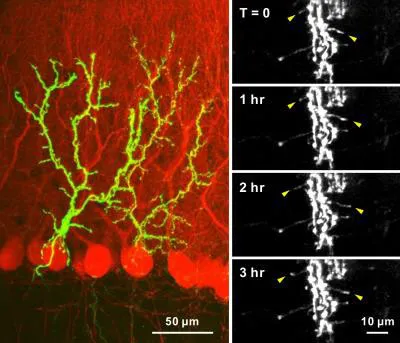
The brains of young people are very flexible—one reason teens can be so flighty and forgetful. But scientists have long thought that by adulthood, the circuitry becomes hard-wired and truly fixed in place. A new look inside grown-up mouse brains reveals far more literal flexibility than expected, however. (Mice are considered good analogues for human physiology.) Researchers injected fluorescent dye into the brains of live mice to light up neurons, which carry the brain's electrical signals. They viewed these neurons through windows cut into in the skulls of the rodents. Then the scientists looked at neurons that extend fibers, called axons, to send signals to a brain's cerebellum, which helps coordinate movements and sensory information. Like a growing tree, axons have a primary trunk with several branches. The main trunk was firmly connected to other target neurons in the cerebellum, as expected. But the side branches "swayed like kite tails in the wind,” said study leader David Linden of Johns Hopkins University in Baltimore. Over the course of a few hours, individual side branches would elongate, retract and morph in a highly dynamic fashion. The side branches failed to make conventional connections, or synapses, with adjacent neurons. The findings are a mystery, but Linden thinks they may present a second mechanism for conveying information beyond traditional synapses. Or maybe the swaying in the gray-matter wind assists in nerve regeneration, quickly forming synapses should nearby nerves get damaged. The study is detailed in the Nov. 8 issue of the journal Neuron.