













Tornado Outbreak Sets October Record

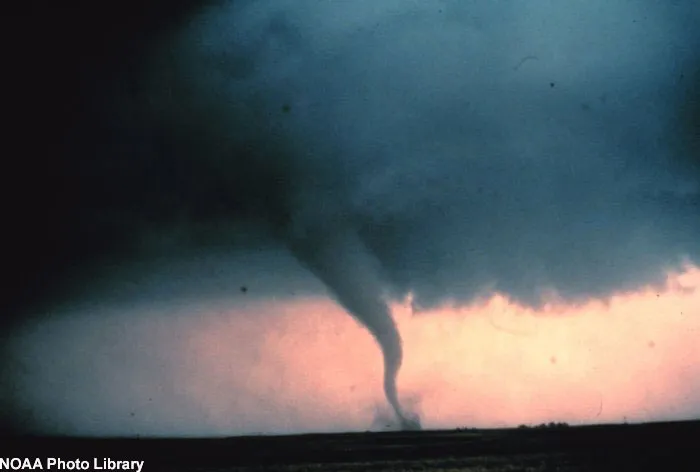
Last month saw a record October for tornado outbreaks, with 87 twisters forming in just one three-day span, government meteorologists announced today.
The outbreak, from Oct. 17 through Oct. 19, surpassed the previous record of 63 tornadoes set along the Gulf Coast from Oct. 23 through Oct. 27 in 1997, according to the National Oceanic and Atmospheric Administration (NOAA).
The total number of tornadoes reported in October, 105, came in second behind the 117 tornadoes reported in October 2001. Records go back to 1950.
The massive outbreak occurred because two weather systems that had high potential to form tornadoes were simultaneously positioned over the country.
“The positioning of the jet stream from southwest Texas to northeast Michigan with readily available moisture streaming inland from the Gulf created conditions favorable for tornado activity in the country’s mid-section,” said Joe Schaefer, director of NOAA's Storm Prediction Center.
A low pressure system was the primary cause of storms that produced six tornadoes on Oct. 17 through the morning of Oct. 19 in the coastal regions of Texas, Louisiana, Mississippi and the Florida Panhandle.
The remaining 81 tornadoes were produced by a system of low pressure that extended from the Central Plains to the Great Lakes. Intense thunderstorms developed ahead of the system, spawning tornadoes from southwestern Missouri to Michigan. Five fatalities, two in Missouri and three in Michigan, were associated with these storms.
Get the world’s most fascinating discoveries delivered straight to your inbox.
Though tornadoes form more often in the spring months, conditions favorable to their development can certainly occur in the fall.
“These storms are a reminder to all that tornadoes can develop any time of year, and anywhere,” said Schaefer. “When severe weather is forecast, people should stay on top of developments closely. Monitor television and radio or listen to NOAA Weather Radio All Hazards, the fastest and most direct link to hazard watches and warnings from local National Weather Service forecast offices.”
- Tornado Videos: Chasing the Beast
- Do Tornadoes Strike Only in Spring?
- Top 10 Killer Tornadoes

Andrea Thompson is an associate editor at Scientific American, where she covers sustainability, energy and the environment. Prior to that, she was a senior writer covering climate science at Climate Central and a reporter and editor at Live Science, where she primarily covered Earth science and the environment. She holds a graduate degree in science health and environmental reporting from New York University, as well as a bachelor of science and and masters of science in atmospheric chemistry from the Georgia Institute of Technology.