Three of the U.S. military's newest recruits reported for duty this week at the Army Test and Evaluation Command. These troops are different from normal soldiers in several ways—for starters, each has six feet. And they are robots designed to look and move like cockroaches. Aside from those details, the Army is hoping its new Boston Robotics RHex bots will soon join grunts in Afghanistan.
RHex furthers the U.S. military's ongoing efforts to deploy aerial drones and land robots to assist troops in the field. Weighing 13.5 kilograms, the camera-equipped RHex is designed to be carried in a backpack until it is needed to provide reconnaissance in rough terrain areas such as rocky inclines, riverbanks, mud and loose sandy soil. A fully charged robot can operate via remote control for six hours at a distance of up to 600 meters from its controller.
The key to RHex's mobility is the shape of its feet, which resemble apostrophes and swing in circles, slapping the ground to propel the bot forward (see video). The feet can also serve as paddles in water. RHex moves much like a similar, four-legged robot developed a few years ago by a team of Georgia Institute of Technology, Northwestern University, and University of Pennsylvania researchers.
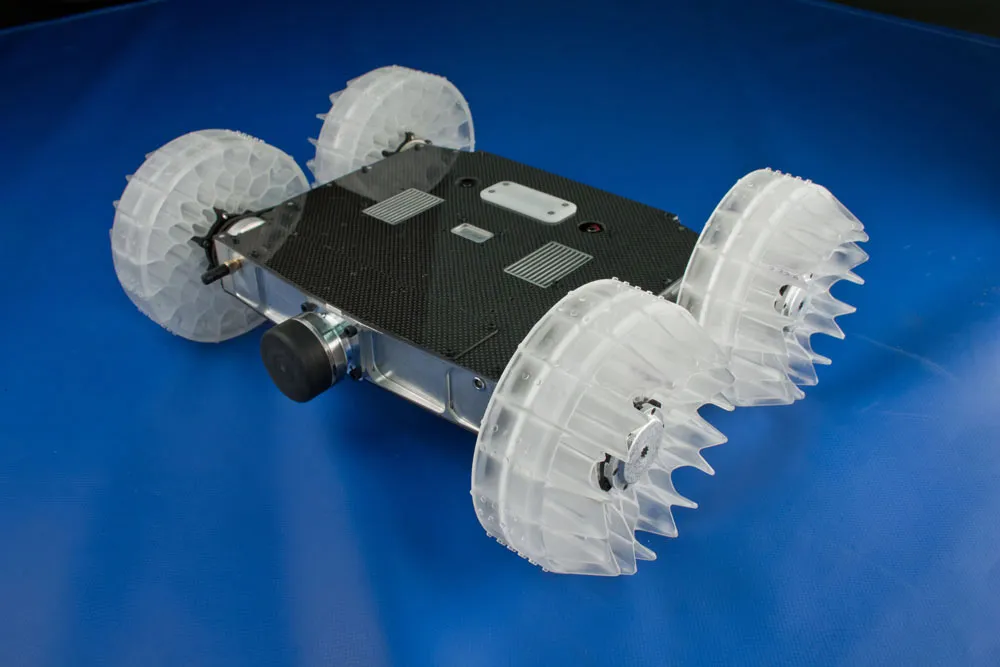
The Army Rapid Equipping Force plans to deliver four RHex robots for testing in Afghanistan once safety evaluations are completed stateside. These bots could be joined shortly by nine Boston Dynamics so-called Sand Flea reconnaissance robots, expected to undergo similar tests later this year. Sand Flea is a four-wheel, five-kilogram dynamo that drives like a remote-control car on flat surfaces but can jump as high as nine meters to overcome obstacles (see video). The robot, which can pop up about 25 times on a single charge, uses gyro stabilization to stay level while airborne both to provide clear recon from its onboard camera and to ensure a smooth landing. Earlier versions of Sand Flea were developed by Sandia National Laboratories with funding from the Defense Advanced Research Projects Agency (DARPA) and the Army's Joint Improvised Explosive Device Defeat Organization (JIEDDO).
Boston Dynamics has several other robots in the works for the military, including its Legged Squad Support System (LS3) and a fleet-footed newcomer called Cheetah that can run nearly 30 kilometers per hour, breaking the 21 kph land speed record for legged robots set in 1989 at the Leg Laboratory, part of the Massachusetts Institute of Technology's Computer Science and Artificial Intelligence Lab.
The Cheetah is a four-footed robot that gallops at 18 mph, which is a land speed record for legged robots.
(Image credit: Image courtesy of Boston Dynamics)
Like its namesake in the animal kingdom, the mechanized Cheetah increases its stride and running speed by flexing and un-flexing its metallic spine on every step. The Cheetah is confined to a laboratory treadmill for now because it is connected to a hydraulic pump for power and tethered to a boomlike device overhead to keep it running in the center of the mill. Boston Dynamics designed the treadmill to move at speeds up to more than 80 kph—child's play for a real cheetah, which can run upward of 120 kph, faster than any other land animal.
It is too early to tell exactly when Cheetah, (or Sand Flea and RHex, for that matter) might see action alongside troops and how it will be utilized, but one idea is to use it as a robotic scout that can move swiftly through rougher terrain than today's wheeled or tracked robots.
Sign up for the Live Science daily newsletter now
Get the world’s most fascinating discoveries delivered straight to your inbox.
DARPA, sponsoring Boston Dynamics's Cheetah work through its Maximum Mobility and Manipulation (M3) program, hopes to see a free-running prototype by the end of the year.
Right now Cheetah is more of a basic research project than a program with a specific mission, says Boston Dynamics founder Marc Raibert. "The emphasis is on getting fundamental results that could have broad impact in advancing robotics," he adds. "Indeed, work on the Cheetah robot has already forced us to rethink how a back works in locomotion to increase running speed, and to create better models for the measurement and exchange of momentum in legged locomotion."