
 Live Science Plus


Robot Fish Leads the School

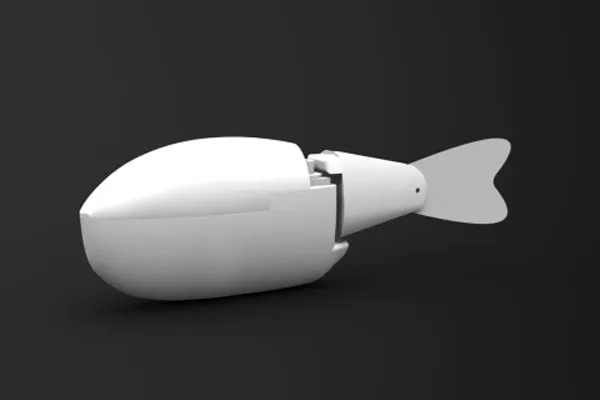
Engineers have designed a robot fish that, under the right conditions, becomes head of the pack.
Robots like this one could be used to lead schools of fish away from oil spills, underwater turbines or other dangers, and they could also offer scientists a new tool with which to study fish behavior, said Maurizio Porfiri, an associate professor of mechanical engineering at Polytechnic Institute of New York University.

The robot in question was designed to swim, but not look, like a fish. Made of plastic and about 4 inches (10 centimeters) long, it has a rigid body and a two-segmented tail. The end of the tail is flexible and propelled from side to side by a motor.
Porfiri and fellow researcher Stefano Marras placed the robot fish in a water tunnel with smaller, live fish, called golden shiners. The researchers varied the speed at which the robot beat its tail and the speed of the flowing water. They then watched to see where the live fish positioned themselves.
When the robot didn't move, the fish did not respond to it. But, with the right combination of tail beats and water velocity, about 60 percent to 70 percent of the live fish fell in behind the robot, Porfiri said.
They found that if the water was flowing at about 5.5 inches (14 centimeters) per second, the fish responded best to a tail-beat frequency of about two cycles per second. If the velocity of the water increased, then the fish responded better to three beats per second.
"Fish like to be in the wake," Porfiri said. "We measured the tail-beat frequency of the fish in front of the robot and in this particular location (in back), and if you find a fish that is holding station in back of the robot, it swims at the same speed, but beats at a lower frequency."
Swimming in the robot's wake allows the fish to save energy, in other words.
The research, funded by the National Science Foundation, was published online Feb. 22 in the Journal of the Royal Society Interface.
You can follow LiveScience senior writer Wynne Parry on Twitter @Wynne_Parry. Follow LiveScience for the latest in science news and discoveries on Twitter @livescience and on Facebook.
