













Crafty Caterpillars Mimic Each Other to Avoid Predators

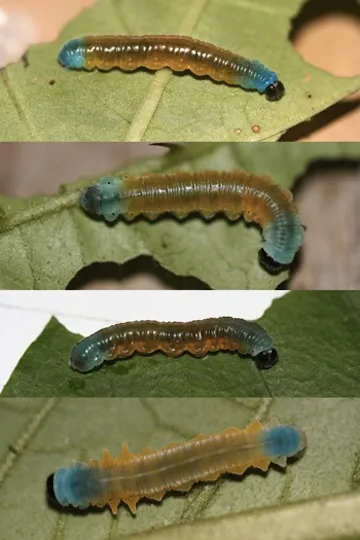
Scientists have long documented mimicry in adult butterflies, but new research shows that caterpillars also use this defense mechanism to deter predators.
To protect themselves from hungry predators, caterpillars have evolved a number of defenses. Some caterpillars physically camouflage themselves to look like bird droppings or sticks, while others have developed fake eyes to scare off birds. Some caterpillars even have chemical defenses gained from poisonous plants, which they then broadcast to predators with a bright warning coloration.
Although many adult butterflies employ mimicry — where one species develops warning color patterns similar to another species' — to quickly teach predators which insects to avoid, scientists have observed few definitive cases of caterpillars using this strategy.
"Mimicry in general is one of the best and earliest-studied examples of natural selection, and it can help us learn where evolutionary adaptations come from," University of Florida biologist Keith Willmott said in a statement.
Two mimics
In the new study, Willmott and his colleagues focused on two caterpillar groups: the Danaini of the Caribbean Island of Hispaniola and the Ithomiini of the upper Amazon in eastern Ecuador.
In the continental United States, Danaus plexippus (Monarch Butterfly) and Danaus gilippus (Queen Butterfly) caterpillars have a similar white-, black- and yellow-band pattern on their bodies. Throughout the Dominican Republic, however, the same caterpillar species have much broader black bands, giving them a distinct, darker coloration.
Get the world’s most fascinating discoveries delivered straight to your inbox.
The researchers found that this broad-band pattern is present in several other toxic Danaini species endemic to Hispaniola, suggesting that D. plexippus and D. gilippus copied this trait from the endemic species when they arrived in the area.
Costs of mimicry
In Ecuador, the researchers found that 22 of 41 Ithomiini caterpillar species displayed some kind of warning coloration. Many of the species displayed a pattern of black, white and yellow bands, but the researchers concluded that mimicry was not likely involved because the patterns are geographically widespread and not sufficiently similar.
However, the researchers found five species that displayed a previously undocumented pattern of a bright yellow body with blue tips. They believe that four of the innocuous species likely mimicked the toxic Forbestra olivencia— a phenomenon known as Batesian mimicry.
"They act almost like parasites, because the mimics are actually edible and therefore deceive predators without having to invest in costly resources to maintain toxicity," Willmott said. "Such a system can only be stable when the mimics are relatively rare, otherwise predators will learn the trick and attack more individuals of both mimics and models, driving models to evolve novel color patterns to escape the predators."
The researchers believe that mimicry is more rare in caterpillars than butterflies because a bright coloration is more costly to the caterpillars. Unlike highly mobile adult butterflies, caterpillars are unable to easily evade predators they attract with their bright colors.
The research was published in the November issue of the journal Annals of the Entomological Society of America.
