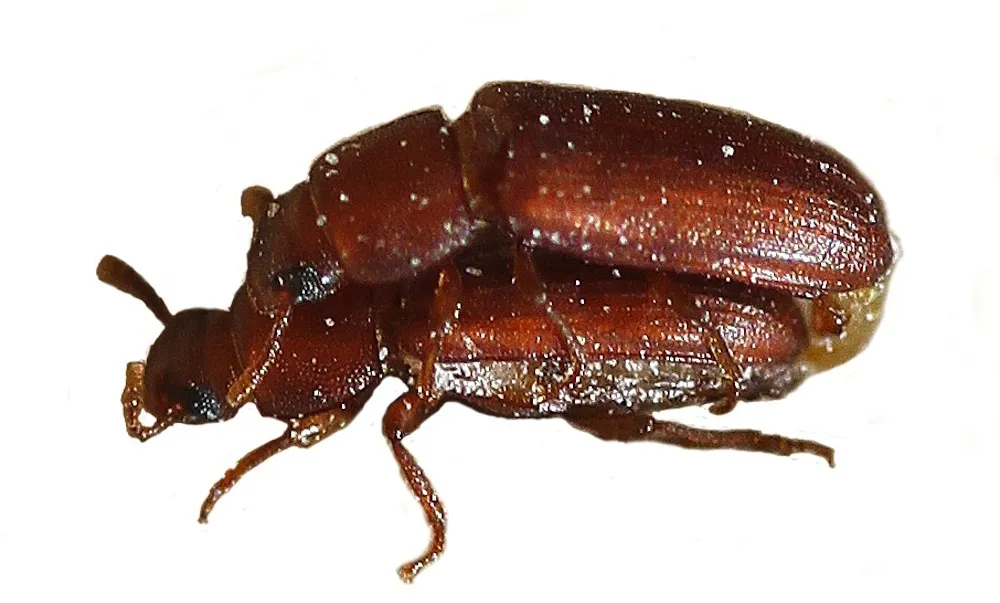
What drives a female to sleep around? For red flour beetles, too much inbreeding may do the trick, according to new research showing that when populations of the beetles become inbred, females get frisky.
Mating with multiple males has its downsides. When females mate at high frequencies, they end up being less fit, and can even sustain injuries or suffer from exhaustion. Mating with just one male should suffice to impregnate a female, so the researchers wondered why females would sleep around.
Both lab-based and natural populations of these beetles often undergo population drops that result in severely inbred communities, study researcher Matthew Gage, of the University of East Anglia in the U.K., said in an email to LiveScience. His team showed that these inbred communities promote promiscuity in female red flour beetles, and that this promiscuous mating results in more offspring.
By growing two populations of red flour beetles in the lab, a genetically healthy population and an inbred one lacking genetic diversity, the team was able to make the females of the group more promiscuous. The females were quicker to mate, mated with more males and for longer periods of time than females from a large population that hadn't inbred and consequently put a squeeze or bottleneck on genetic diversity.
The researchers found that when females from the inbred population were promiscuous, they approximately doubled the number of surviving offspring. When the researchers turned the beetles from the healthy population promiscuous by having each female mate with five males, there was no similar boost in offspring survival rate.
These differences weren't caused by any fault of the males; they were just as fertile in the inbred population as they were in the normal population.
Sign up for the Live Science daily newsletter now
Get the world’s most fascinating discoveries delivered straight to your inbox.
In addition, the females' promiscuity passed down to their daughters, and since they had many more offspring than nonpromiscuous females, the trait spread throughout the population quickly.
Finding the right mate
Magnified spermatozoan of a Tribolium castaneum flour beetle. Competition between sperm of different males within a female reproductive tract, leading to selection of compatible sperm, could explain why promiscuous inbred females have higher fitness than females that were mated to single males.
(Image credit: ?ukasz Michalczyk)
This increased promiscuity means in a bottlenecked population, possibly harmful genes can be found more frequently, so being able to mate with more males could be beneficial to females. That's because the females end up with lots of options for which sperm fertilize their eggs; in that way, they can avoid fertilizing their eggs with sperm from genetically incompatible mates, such as those closely related to them.
"Males with these kind of genetic problems will not necessarily make good reproductive partners, as offspring might also inherit these problems," Gage said. "If you only mate with one male, then his sperm will be the fertilizers, so mating polyandrously allows more intense selection of the better males and their sperm."
How this sperm selection happens isn't known, but Gage has some ideas: "It’s possible that female beetles can smell how closely related they are to the male, and either avoid mating with those males, or don’t encourage sperm storage after mating with them."
The study was published today (Sept. 22) in the journal Science.
You can follow LiveScience staff writer Jennifer Welsh on Twitter @microbelover. Follow LiveScience for the latest in science news and discoveries on Twitter @livescience and on Facebook.
Jennifer Welsh is a Connecticut-based science writer and editor and a regular contributor to Live Science. She also has several years of bench work in cancer research and anti-viral drug discovery under her belt. She has previously written for Science News, VerywellHealth, The Scientist, Discover Magazine, WIRED Science, and Business Insider.