


Unsolved Mystery: Why Are Moths Drawn to Artificial Lights?

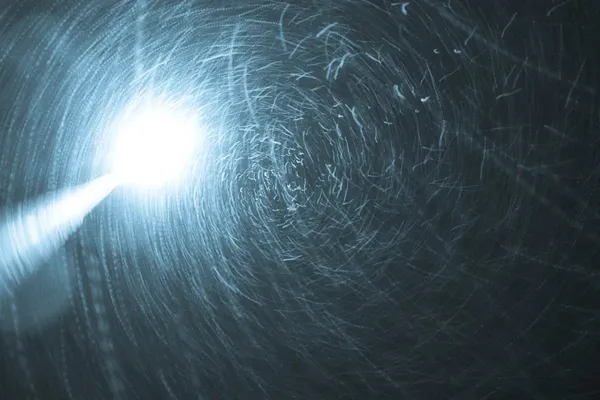
The old saying "like a moth to a flame" describes someone with an unswerving yet self-destructive attraction. Where people are concerned, the underlying motivation for such behavior can usually be identified, whether it's greed, lust or the thrill of the chase.
Not so with moths. There are a handful of theories as to why the insects make their suicidal nosedives toward burning candles and artificial lights. But, perhaps surprisingly, that's all they are — guesses. And they're not particularly good ones, either.
Some entomologists believe moths zoom toward unnatural light sources because the lights throw off their internal navigation systems. Moths didn't evolve around bright lights, after all; they evolved at a time when all the light on Earth came solely from the distant sun, moon and stars. In a behavior called transverse orientation, some insects navigate by flying at a constant angle relative to a distant light source, such as the moon.

But around man-made lights, such as a campfire or your porch light, the angle to the light source changes as a moth flies by. This confuses it. "The thinking is that they become dazzled by the light and are somehow attracted," said Jerry Powell, an entomologist at the University of California, Berkeley, who specializes in moths.
This theory runs into some problems, however. Light bulbs may be new on evolutionary time scales, but campfires have been around for about 400,000 years. Wouldn't natural selection have killed off moths whose instinct tells them to go kamikaze every time they feel blinded by the light?
Furthermore, moths may not even use transverse navigation. "I'm dubious of the idea that they're using moonlight as an orienting device in the first place," Powell told Life's Little Mysteries, a sister site to LiveScience. "That would probably only be done by species that migrate — in that process they might use the moon in some way. But that would not explain why the 50 or 70 percent of moths that are small and don't migrate would also use moonlight to navigate."
A completely different theory was first put forth in the 1970s by Philip Callahan, an entomologist then working with the U.S. Department of Agriculture. Callahan discovered that the infrared light spectrum emitted by a candle flame happens to contain a few of the exact same frequencies of light given off by female moths' pheromones, or sex hormones. Callahan had previously discovered that the pheromones are luminescent — they glow very faintly.
Get the world’s most fascinating discoveries delivered straight to your inbox.
In short, male moths are attracted to candles under the false belief that they are females sending out sex signals. "The male moth is highly attracted to and dies attempting to mate with the candle flame," Callahan wrote in a 1977 paper in Applied Optics.
This hypothesis has its holes, too. According to Powell, ultraviolet light is far more attractive to insects of various kinds, including moths, than infrared light is. And there's no reason why UV light should remind moths of sex; it doesn't contain the same wavelengths as their glowing pheromones.
Entomologists have found that moths are less attracted to artificial lights during the week of the full moon than they are during the new moon week, and this observation has sparked yet another theory. "People used to say you don't capture many moths with UV lamps at the time of the full moon because they're all flying toward the moon," Powell said. "But that's ridiculous, because they can't carry on their life cycles if they're flying to the moon."
And indeed, the notion has been proven incorrect. "A study done in Scandinavia found out that it's not that they aren't attracted to lights as much when the moon is bright, it's that they aren't as active during that time because the light doesn't drop off as much at night," he said. Usually, he explained, nightfall and darkness trigger moth activity.
So no hypothesis holds water. Why is a moth "like a moth to a flame?" For now, the question must remain one of life's biggest little mysteries.
This article was provided by Life's Little Mysteries, a sister site to LiveScience. Follow Natalie Wolchover on Twitter @nattyover

Natalie Wolchover was a staff writer for Live Science from 2010 to 2012 and is currently a senior physics writer and editor for Quanta Magazine. She holds a bachelor's degree in physics from Tufts University and has studied physics at the University of California, Berkeley. Along with the staff of Quanta, Wolchover won the 2022 Pulitzer Prize for explanatory writing for her work on the building of the James Webb Space Telescope. Her work has also appeared in the The Best American Science and Nature Writing and The Best Writing on Mathematics, Nature, The New Yorker and Popular Science. She was the 2016 winner of the Evert Clark/Seth Payne Award, an annual prize for young science journalists, as well as the winner of the 2017 Science Communication Award for the American Institute of Physics.