













Intricate Wings Gallery: The Color of Ancient Moths

Fossil Moth
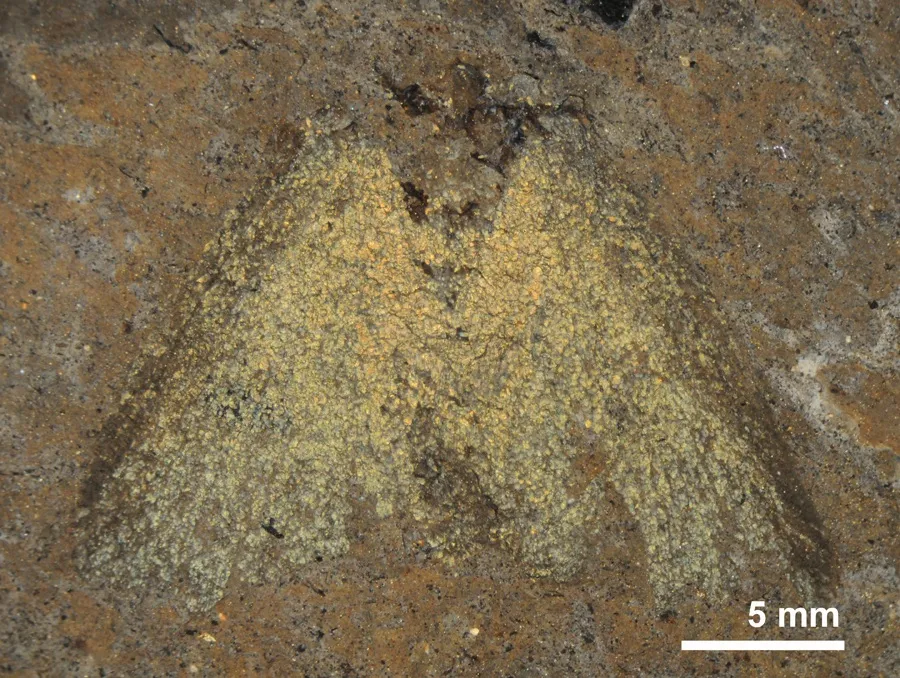
A 47-million-year-old fossil moth from Messel, Germany. The moth is in glycerine, which make its structural colors appear yellow.
Close-up Colors

A 47-million-year-old fossil moth wing looks yellow in glycerine. When the moth was alive, the colors would have appeared yellow-green.
Moth Reconstruction

An illustration of what the moth's wing patterns looked like in life.
Fossil Detail

A scanning electron micrograph (SEM image) of the surface of one of the fossil scales showing ridges, microribs, crossribs and perforations
Fossil Moth Scale

Different scale types have different structures. This is an SEM image of a "satin-type" scale.
Fossil Ridges

A scanning electron micrograph (SEM image) of the surface of one of the fossil scales showing microstructures: ridges, microribs and crossribs
Fossil Scales

Complex structures in moth scales create the colors of the insects' wings. This is a transmission electron micrograph (TEM image) of a fossil scale showing curved surfaces in between the ridges.
Get the world’s most fascinating discoveries delivered straight to your inbox.

Stephanie Pappas is a contributing writer for Live Science, covering topics ranging from geoscience to archaeology to the human brain and behavior. She was previously a senior writer for Live Science but is now a freelancer based in Denver, Colorado, and regularly contributes to Scientific American and The Monitor, the monthly magazine of the American Psychological Association. Stephanie received a bachelor's degree in psychology from the University of South Carolina and a graduate certificate in science communication from the University of California, Santa Cruz.