














Short Shark Supply: Great White Population Low, Census Finds

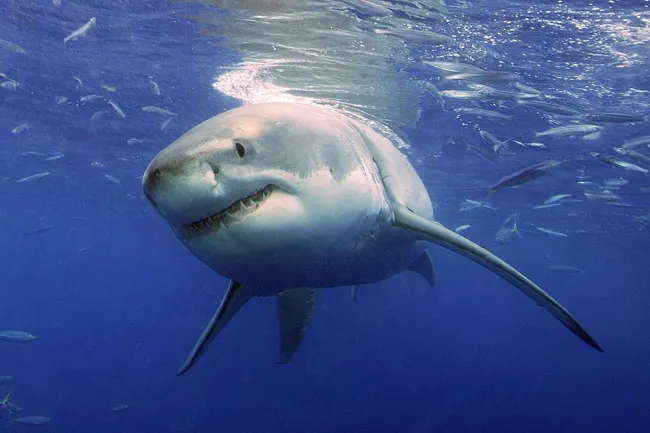
Far fewer great white sharks are cruising the waters off of California than previously thought, according to researchers who conducted a unique shark census in the northeastern Pacific Ocean.
"This low number was a real surprise," said Taylor Chapple, a doctoral student at the University of California, Davis when he led the great white shark study.
"It's lower than we expected, and also substantially smaller than populations of other large marine predators, such as killer whales and polar bears," said Chapple, now a postdoctoral researcher at the Max Planck Institute in Germany.
Counting the great white sharks was a hands-on activity. The researchers went out into the Pacific Ocean in small boats to places where great white sharks congregate, and lured the massive predators into photo range using a seal-shaped decoy on a fishing line.
From 321 photographs of the uniquely jagged edges of the sharks' dorsal fins, they identified 131 individual sharks.
From these data, they used statistical methods to estimate that there are 219 great white sharks in the region.
"We've found that these white sharks return to the same regions of the coast year after year," said study co-author Barbara Block, a Stanford University marine biologist and a leading expert on sharks. "It is this fact that makes it possible to estimate their numbers. Our goal is to keep track of our ocean predators."
Get the world’s most fascinating discoveries delivered straight to your inbox.
The study, published in the journal Biology Letters, is the first rigorous scientific estimate of white shark numbers in the northeast Pacific Ocean, and represents one of the best estimates among the world's three known white-shark populations.
Great white sharks also live in the waters around Australia and New Zealand, and off the coast of South Africa.
Shark species around the globe have suffered steep declines in recent years. As many as one-third of the world's sharks and other cartilaginous fishes are threatened, and shark numbers along the United States eastern seaboard have plummeted, some species by as much as 90 percent.
Great white sharks are classified as "vulnerable" by the International Union for the Conservation of Nature, but relatively little is known about the elusive species.
"This estimate only represents a single point in time," Chapple said. "Further research will tell us if this number represents a healthy, viable population, or one critically in danger of collapse, or something in-between."
Satellite tagging studies have demonstrated that great white sharks in the northeast Pacific make annual migrations from coastal areas in Central California and Guadalupe Island, Mexico, out to the Hawaiian Islands or to the "White Shark Café," a region of the open ocean between the Baja Peninsula and Hawaii where white sharks have been found to congregate – after which they then return to the coastal areas.
