













New Airplane Design Mimics a Seagull

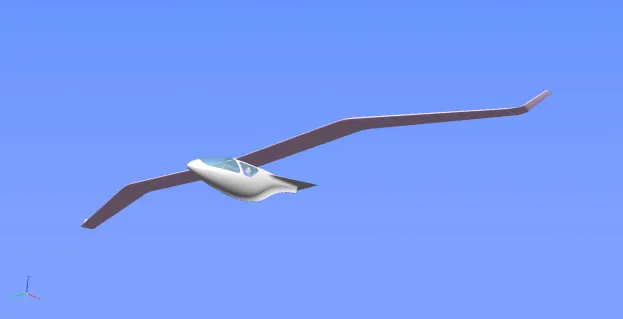
An attempt to redesign the airplane resulted in a surprising craft, one that mimicked a familiar, if much smaller, flyer: a seagull.
In a bid to increase the energy efficiency of the familiar tube-with-wings architecture, Joachim Huyssen, of Northwest University in South Africa, began by thinking about the basic principles of aerodynamics, according to his collaborator, Geoffrey Spedding, of the University of Southern California.
The design they ultimately generated has crooked wings, a stubby body and, the key innovation, a short tail. While it is intended to increase fuel efficiency by reducing drag, it's not yet clear just how much of an effect the redesign will have, according to Spedding. [Gallery of Unique Aircraft]
Although not intentional in this case, it's not uncommon for designers to turn to nature for inspiration.
It hasn't always been that way, according to Spedding. Paradoxically, the great success in human flight came when we stopped trying to mimic natural flyers and began designing from scratch. Birds and bats use their wings to generate both thrust and lift. However, human flying machines weren't successful until we separated the wings, which generate lift, from the engine, which generates thrust, he said.
Since 1903, when the Wright Brothers took their first flight, that design was tweaked into the familiar one of today.
The conventional design works well, and redesigning to increase energy efficiency re-opens all the other factors taken into consideration in the architecture of an airplane, such as where people will sit, that have already been resolved, he said. However, "in this day and age of fuel prices where 1 or 2 percent can make a huge difference, it's worth wondering if there could be improvements."
Get the world’s most fascinating discoveries delivered straight to your inbox.
Huyssen brought his ideas to Spedding while both were in South Africa. The central innovation of the new design is a short, stubby tail that makes airflow around the body compatible with the flow around the wings (so the two don't slam into each other and make more drag), making the entire design more aerodynamically efficient.
In a conventional airplane, the tail controls pitch, which is whether the nose is pointed up or down. In the new design, the engineers moved this feature to the wings, where they added a slight crook for what they call the "gull wing configuration." This allows the wings to control pitch stability, and eliminates the need for a conventional tail. This, in turn, liberated them from the elongated tube body, or fuselage, of a conventional aircraft.
In Huyssen and Spedding's design, the fuselage became shorter, fatter, but "funnily enough, more streamlined at the same time," Spedding said.
They are scheduled to present their work on Sunday, Nov. 19 at the American Physical Society Division of Fluid Dynamics meeting in Long Beach, Calif.
