SPECIAL REPORT: Thinking Beyond Oil

By LiveScience Staff

posted: 26 August 2005 10:18 am ET

"There is tremendous potential in the oceans to supply energy for the world."
Annette von Jouanne, an Oregon State electrical engineering professor


AS THE PRICE OF A BARREL OF OIL continues to surge and oil traders eye possible disruptions in production from hurricane Katrina, scientists are turning to the ocean as a possible source of alternative energy.

Many forms of renewable energy have been contemplated, and of course solar and wind power plants are already in use. But so far, only a small fraction of the world's energy production comes from renewable resources.

President George W. Bush has talked of a hydrogen economy, in which abundant energy would be extracted from water and the tailpipes of cars would be clean. But extracting hydrogen from water requires energy -- fossil fuels or nuclear power, for example. Many scientists say technology will never allow the extraction of a enough hydrogen to make up for the energy needed to do the extracting.

Learn More


Power of the Future: 10 Ways to Run the 21st Century


Wave Energy:
How It's Extracted


Monster Waves


Oil Prices Remain High as Traders Eye Katrina

End of Oil Could Fuel 'End of Civilization as We Know It

Windmills to Change Local and Global Climates

Hurricane Katrina Update

Scientists have even proposed giant space projects to capture solar energy above the clouds and beam it back to Earth. Those proposals have not come close to getting off the ground, however.

High stakes

Meanwhile, scientists agree that the world will eventually have to rely on something besides oil. Just when the crude will stop bubbling is a matter of huge debate. One scientists says the slow decline will begin later this year. If the wells go truly dry later in this century, as some experts figure, the major nations of an unprepared world might be drawn into all-out war.

"The oil will run out," says Caltech physicist David Goodstein. "The only question is when."

The strain is already building. The United States now imports nearly 60 percent of the oil it uses. China's oil consumption is expected to grow 7.5 percent per year, and India’s by 5.5 percent, according to the Institute for the Analysis of Global Security.

But so far, no renewable resource has been developed to the point that it could replace oil.

The new wave

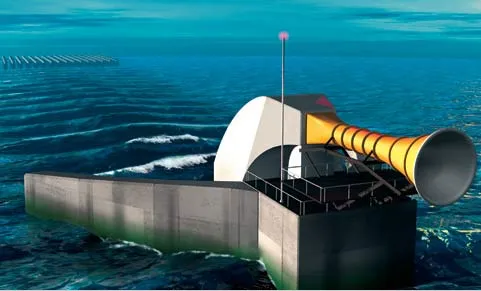
The potential for harnessing the power of waves has drawn serious study by Oregon State University, federal and state agencies, and communities along the Oregon Coast.

"There's a real good chance that Oregon could turn into kind of the focal point in the United States for wave energy development and I think that would be a boon to the economy,'' said Gary Cockrum, spokesman for the Central Lincoln People's Utility District.

Groups hoping to begin work on experimental technology are considering the International Paper mill site in Gardiner.

"We have a lot of momentum going for it, I think, but we still have to work out lot of details,'' said Alan Wallace, Oregon State University professor of electrical engineering.

The plan is to take over the site to make it a showcase for a "renewable ocean extraction system,'' he said.

Tremendous potential

Last Friday at the Port of Umpqua office in Reedsport, officials from Oregon Department of Energy, Oregon State University, Electrical Power Research Institute and other federal and state officials gathered to explain the fledgling project to more than 100 southern Oregon Coast residents.

"There is tremendous potential in the oceans to supply energy for the world,'' Annette von Jouanne, an Oregon State electrical engineering professor told the crowd. "A 10-square-mile wave power plant could supply the entire state of Oregon.''

The electric institute and the Bonneville Power Administration identified the Gardiner site as the ideal place for the project in their feasibility study.

The former mill has an outflow pipe already in place -- a structure that could reduce the cost of building a power plant. Electricity from the Gardiner site could be transmitted to other stations up and down the coast.

The biggest obstacle

Money is the biggest obstacle. It will take about $5 million to complete the project's initial phases. But the recently passed federal energy bill could reduce much of that burden.

U.S. Rep. Peter DeFazio, D-Ore., who is visiting the southern Coast this week, called the project "intriguing.'' He added: "I would definitely be supportive.''

At first, he was skeptical that a system could function along the Pacific Northwest Coast, famous for its rough seas. But he said he's seen a similar system operate successfully off the coast of Scotland.

How much energy could be generated from the water is still unclear, but those involved with the project say the possibilities could be limitless.

"I read something involved with this that said if 0.2 percent of the ocean's energy were harnessed, it could produce enough energy to power the entire world,'' added Cockrum, the utility district spokesman.

On Friday, oil prices held above $67 a barrel as forecasters said hurricane Katrina would move out into the Gulf, where oil platforms have already experienced disruptions from other storms this year.

The Associated Press contributed to this report.

Advertisement

Related Items from the LiveScience Store

  1. Go to Store
  2. Go to Store

More Stores to Explore

World Travel - iExplore.com
Adventure Travel - iExplore.com
Region:
Country:
Activity: