














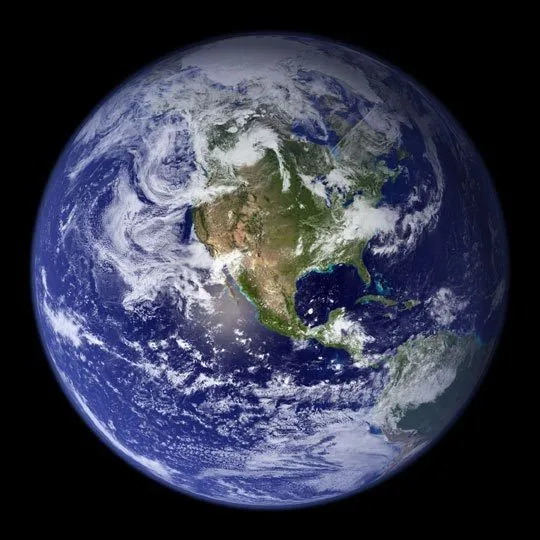
Well, they're not! But let's pretend they are for a moment. Here's how it works:
Gravity pulls uniformly in all spatial directions (all else being equal). The more matter a forming planet attracts, the stronger the gravitational pull towards its center becomes. A sphere is the natural outcome of such a situation; deviations from roundness must muster the non-gravitational forces to withstand the force of gravity pulling downward. (Small deviations, from mountains to your own body, do this.)
However, the story isn't quite so simple. Newton's laws of motion state that a moving body tends to keep moving, and matter at a planet's equator can be rotating with enough speed to create an outward bulge (Earth has one, too). So planets aren't perfectly round, after all. Their "roundness" depends on mass, size and rotation speed. Scientists can deduce the mass of a planet easily if it has a satellite (say, a moon) by applying Newton's laws to the moon's orbit to get a simple equation relating the planet's mass to the satellite's speed.
Follow Life's Little Mysteries on Twitter @llmysteries. We're also on Facebook & Google+.
Feed your curiosity with an exclusive mystery every week, solved with science and delivered direct to your inbox before it's seen anywhere else.