













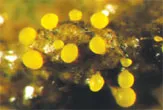
A single genetic mutation is all it takes to transform selfish bacteria into altruistic team players that contribute resources to the entire group, even when they themselves might not survive to benefit, a new study shows.
One result can be a "superstrain" of survivors.
The finding, detailed in the May 18 issue of the journal Nature, demonstrates how simple genetic changes can lead to relatively complex forms of cooperation, said study leader Gregory Velicer from the Max-Planck Institute for Developmental Biology in Germany.
When food becomes scarce, social bacteria Myxococcus xanthus clump together into hardy spores that can withstand environmental stresses for long periods of time. A spore is a cocoon of sorts that serves as a seed for future generations.
Each spore of M. xanthus contains about 100,000 starving cells that pool their meager resources. Many cells die during the process and never become part of the spore.
"It's possible that the carcasses of the dead cells are providing nutrients to the cells that will become spores," Velicer told LiveScience.
Some mutated strains of M. xanthus can't form spores on their own but are more efficient than their non-mutated peers at doing so when the two strains are mixed. These so-called cheater strains take over an entire population by out-competing normal strains for the limited spots in the spores.
Get the world’s most fascinating discoveries delivered straight to your inbox.
However, by doing so, the mutant bacteria ensure their own destruction because they require normal cooperative strains to kick start the process of making a spore.
Indeed, in most of the experiments in which cheating and social bacteria were mixed, the entire population died out. But in one special case, the merged population led to the creation of a new superstrain of cooperative bacteria that produced more surviving cells than either of the two original strains.
When the researchers sequenced the superstrain's genome, they discovered that its newfound success was due to a single mutation in the DNA of the cheater bacteria.
The researchers dubbed the new strain "Phoenix" because of its ability to recover from the brink of social collapse.
"A defective social strategy need not be an evolutionary dead end," Velicer said.