













The Secret to Hummingbirds' Amazing Energy
VIRGINIA BEACH, VA—Unlike humans who must fuel up hours before intense exercise, hummingbirds can refuel in mid-flight, according to a new study.
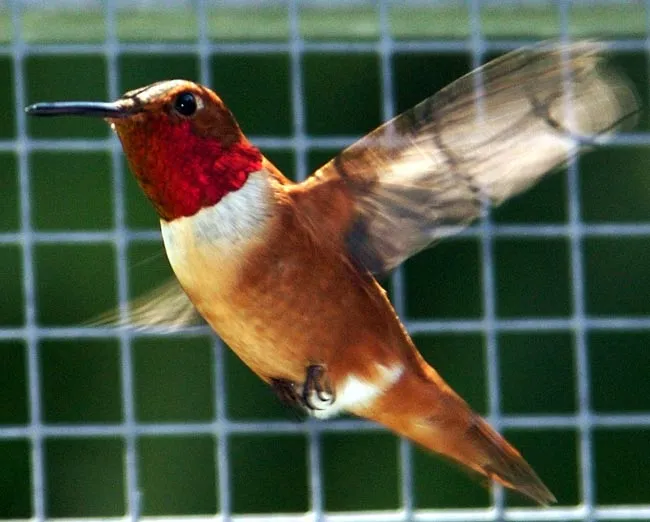
Within several minutes of lapping up sweet nectar, the rufous hummingbird [image] uses the just-ingested sugars to fuel more flying and hovering so it can consume more nectar, a new study finds.
The fast-paced feeding isn't for kicks.
Hummingbirds have the highest energy expenditure of any warm-blooded animal, with a heart rate of up to 500 beat-per-minute, blindingly fast wing beats and sustained hovering. So this bird is nearly always on the edge of starvation, needing to slurp up more than its body weight in nectar each day.
Kenneth Welch and Raul Suarez of the University of California, Santa Barbara fasted hummingbirds before giving them cane nectar, a type of nectar that has a characteristic level of the carbon-13 isotope, a form of carbon having a different number of neutrons. As each bird lapped up the sugary substance, the scientists used a special device on the feeder to measure its oxygen intake—used to calculate energy consumed—and the carbon in its breath.
By comparing the energy requirement with the amount of carbon-13, they showed that within 20 minutes of feeding, the hummingbirds were supporting more than 90 percent of their hovering needs with the cane sugar.
Compare that with a human: An elite cyclist at 60 percent of his maximum aerobic rate can only support 15 to 30 percent of his energy needs with consumed sugars. He needs a high-carb meal such as spaghetti the night before an event in order to process and shuttle the sugar energy to his muscles.
Get the world’s most fascinating discoveries delivered straight to your inbox.
"This is the first time anybody has shown a vertebrate animal able to support such a high fraction of exercise metabolism with very newly ingested sugar," Welch told LiveScience.
Welch presented his finding here today at the annual meeting of the American Physiological Society.
- How Hummingbirds Hover
- Secret of Bird Flight Revealed
- Images: Rare and Exotic Birds
- Video: Extraordinary Birds
- All About Birds
Jeanna Bryner is managing editor of Scientific American. Previously she was editor in chief of Live Science and, prior to that, an editor at Scholastic's Science World magazine. Bryner has an English degree from Salisbury University, a master's degree in biogeochemistry and environmental sciences from the University of Maryland and a graduate science journalism degree from New York University. She has worked as a biologist in Florida, where she monitored wetlands and did field surveys for endangered species, including the gorgeous Florida Scrub Jay. She also received an ocean sciences journalism fellowship from the Woods Hole Oceanographic Institution. She is a firm believer that science is for everyone and that just about everything can be viewed through the lens of science.