













Oldest Known Tyrannosaur Found
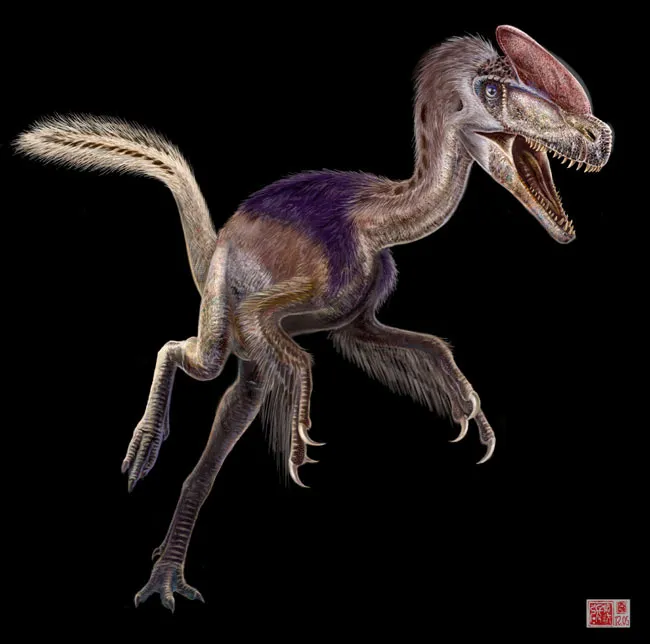
Paleontologists have unearthed two fossilized dinosaurs believed to be the oldest ancestors of the tyrannosaur family, researchers announced today.
The new species had cranial crests and were likely covered in feathers, but were only a third the size of their famous cousin, Tyrannosaurus rex.
Still, the discovery sets back the clock on the tyrannosaur family by at least 30 million years.
This study is detailed in the Feb. 9 issue of the journal Nature.
A ‘crowned dragon'
Two of the new tyrannosaurs, named Guanlong wucaii, a derivation of the Mandarin word for "crowned dragon," were discovered in the Junggar Basin in northwestern China.
The 12-year-old adult specimen was about 9 feet long and 6 or 7 feet tall. A smaller 6-year-old juvenile was found nearby.
Get the world’s most fascinating discoveries delivered straight to your inbox.
Both lived around 160 million years ago during the early Cretaceous period. The previous record-holder for oldest tyrannosaurs was the 130-million-year-old Dilong paradoxous, recently discovered in China by the same researchers.
By comparison, T. rex, which measured about 40 feet long and 15 feet tall, stomped around the Earth during the last stage of the Cretaceous period about 65 million years ago.
G. wucaii sported a two-and-a-half inch tall head crest just a few millimeters thick and filled with air sacs. Scientists say it was comparable to the ornamental features on some living birds, such as cassowaries and hornbills. However, like the crest on duck-billed lambeosaurs, scientists can't say for sure what its purpose was.
"I don't think it would have helped in a fight very much," said co-author Mark Norell of the American Museum of Natural History in New York. "It's very thin and fragile."
Instead, it was more likely used to attract mates or for species identification.
First of its kind
Using mathematical analysis, researchers compared the front teeth, skull, and pelvic features of G. wucaii to other dinosaurs of the time. Although the creature was closely related to coelurosaurs, the researchers determined it was the most primitive tyrannosaur known, making it the first branch on the family tree.
Several of its cranial features, and the long shallow snout, differ from other tyrannosaurs, researchers said. And, similar to other coelurosaurs, its forelimbs are slightly bowed and relatively large compared to the hindlimbs.
"Guanlong shows us how the small coelurosaurian ancestors of tyrannosaurs took the first step that led to the giant T. rex almost 100 million years later," Clark said.
Although G. wucaii's skeletal features are very similar to later tyrannosaurs, it had three fingers, instead of the two found on most advanced tyrannosaurs. Also, it was likely as feathered as a chicken.
"We previously discovered another closely related primitive tyrannosaur, called Dilong paradoxus, that is famous for its feathers," Norell said. "Because they're so closely related, there's no reason at all to think it didn't have feathers."
- A Brief History of Dinosaurs
- Gallery: Dinosaurs that Learned to Fly
- Gallery: Spot Today's Dinosaurs
- Gallery: Dinosaur Fossils