
 Live Science Plus


Great White Shark Sets Ocean-Crossing Record
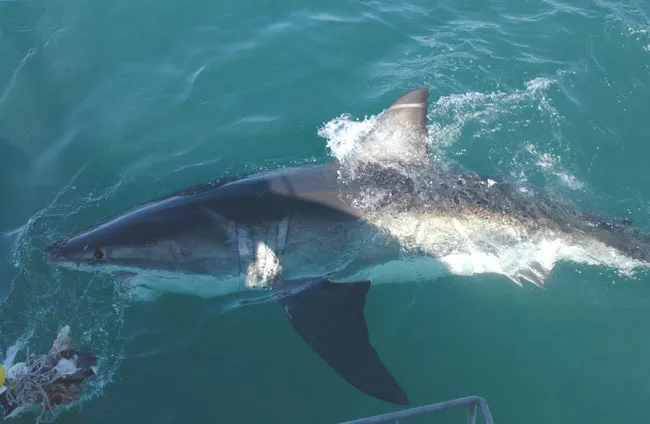
If there were Olympic marathons for fish, this South African entrant would have to be considered the favorite: The great white shark swam to Western Australia and back in nine months.
It's the fastest known back-and-forth crossing of an ocean by any marine organism.
"This is the first individual fish that has been found to go across an entire ocean and come back to the same spot," said study leader Ramón Bonfil of the Wildlife Conservation Society. "The speed that it took to make this trip is one of the fastest long-distance speeds for any swimming animal."

Records are slim on such events, however, so it is unclear whether this great white would have serious competition at the Fish Olympics.
The feat confirms a long-suspected link between two of the world's most important great white shark populations and suggests that great whites may be more vulnerable to open ocean commercial fishing than previously thought.
It also reveals sharks to be surprisingly adept at navigation.
The journey
Get the world’s most fascinating discoveries delivered straight to your inbox.
In Nov. of 2003, researchers tagged a female great white with a pop-off satellite transmitter off the coast of South Africa. More than 6,800 miles and 99 days later, the tag popped off near Western Australia and transmitted data on her journey, including her path and the depth and temperature of the waters she swam in.
Then, about six months after she arrived in Australia, researchers photographed the shark, nicknamed Nicole, back in South Africa.
"There's absolutely no doubt it's the same shark," Bonfil told LiveScience. "It's identifiable by the notches on its fin. It's like a fingerprint."
Bonfil suggests two reasons why a shark would make such an arduous round-trip: food or sex.
Desire to mate sees more likely, since the shark's arrival in Australia coincided with what scientists believe to be mating season in the region. But the hypothesis has holes.
"I don't think it makes sense for a shark to go there for food when it has seals and fish in South Africa," Bonfil said. "However, she isn't the size of a mature female yet, so she can't reproduce."
Perhaps it was a practice run. "She may make the trip all her life," he said.
It could be that Nicole was born in Australia and has a "natural homing" behavior to return there to give birth. Or since continuous inbreeding within a population can cause offspring to express undesirable genetic traits, sharks may make the long-distance mating trip in order to increase the genetic diversity of the population.
Navigation expert
Nicole took a fairly straight path to Australia, suggesting that great whites have outstanding navigational abilities. Migrating marine animals usually navigate using topographic features on the ocean floor, but the path Nicole took crossed very few of these.
Some creatures follow ocean currents "like a subway," Bonfil said, "but there's no such thing in the Indian Ocean."
Nicole spent 61 percent of her time within a few feet of the surface, a previously unreported behavior among great whites, suggesting that she used other navigational clues.
One possibility, which has been suggested for other migratory animals, is that Nicole swam near the surface so she could find her way using celestial cues.
"White sharks have very good vision because they hunt with their eyes, so all the pieces are there to make it possible that they use the sun or the moon to find their way to Australia," said Bonfil.
This research is detailed in the Oct. 7 issue of the journal Science.
- Sharks Everywhere: Vote for Your Favorite
- The Science of Shark Attacks and How to Avoid Them
- Are Great Whites Descended from Mega-Sharks?
- Without Sharks, Food Chain Crumbles
Image Gallery

Great White Sharks