Live Science Plus





You are now subscribed
Your newsletter sign-up was successful
Want to add more newsletters?

Delivered Daily
Daily Newsletter
Sign up for the latest discoveries, groundbreaking research and fascinating breakthroughs that impact you and the wider world direct to your inbox.

Once a week
Life's Little Mysteries
Feed your curiosity with an exclusive mystery every week, solved with science and delivered direct to your inbox before it's seen anywhere else.

Once a week
How It Works
Sign up to our free science & technology newsletter for your weekly fix of fascinating articles, quick quizzes, amazing images, and more

Delivered daily
Space.com Newsletter
Breaking space news, the latest updates on rocket launches, skywatching events and more!
Once a month
Watch This Space
Sign up to our monthly entertainment newsletter to keep up with all our coverage of the latest sci-fi and space movies, tv shows, games and books.

Once a week
Night Sky This Week
Discover this week's must-see night sky events, moon phases, and stunning astrophotos. Sign up for our skywatching newsletter and explore the universe with us!
Join the club
Get full access to premium articles, exclusive features and a growing list of member rewards.
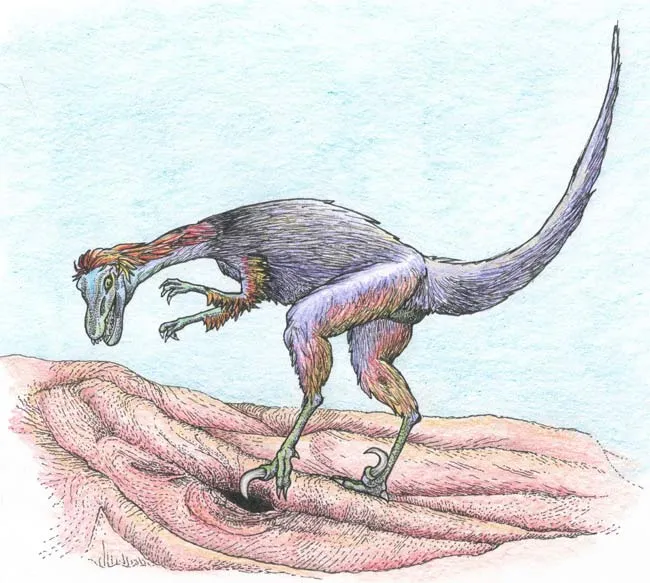
A clawed, predatory dinosaur may have been caught in the act of digging for mammalian prey, scientists now reveal.
The fossils showing the paleo-scene were discovered within sandstone layers in southern Utah, and date back 75 million to 80 million years ago, when the area consisted of windblown dunes.
"We found them about four years ago in July, in 100 degree F (37 degree C) heat," said researcher Edward Simpson, a geologist at Kutztown University in Pennsylvania. "We had scorpions, rattlesnakes, and swarms of gnats."
One set of fossils consists of claw marks from a predatory theropod dinosaur that stood roughly 3 feet (1 meter) tall (at the hips) and 6 feet (2 meters) long — possibly a raptor relative of Deinonychus or Velociraptor. The way these marks are oriented suggest they were made by the creature digging to reach down for something.
Two fossilized burrows were spotted nearby. When compared with other burrows researchers have uncovered over the years, the size and complexity of these newfound ones suggest they belonged to mammals — the smaller burrow to a mouse-sized creature, the larger one to a guinea-pig-sized animal.
The fact these fossils are so close together suggests they are evidence of dinosaurs scrabbling down to prey on mammals, the researchers suggested. Although these fossils could have been made thousands of years apart, if one considers how these dinosaurs lived in the same area as burrowing mammals, "one can then ask why the dinosaurs might have been digging," Simpson said. "If you eliminate other prospects — these aren't footprints, and they're not in symmetrical patterns as we've seen when raking aside earth for a nest — you're left with predatory actions."
"It's often hard to capture the behaviors of dinosaurs in the fossil record to see what they were doing," Simpson told LiveScience. "This is one of the few examples where one might see the impact of their behaviors, which is really cool."
The scientists detailed their findings in the August issue of the journal Geology.
- 25 Amazing Ancient Beasts
- Avian Ancestors: Dinosaurs That Learned to Fly
- Images: Dinosaur Drawings