













Mystery of Great Civilization's Destruction Revealed

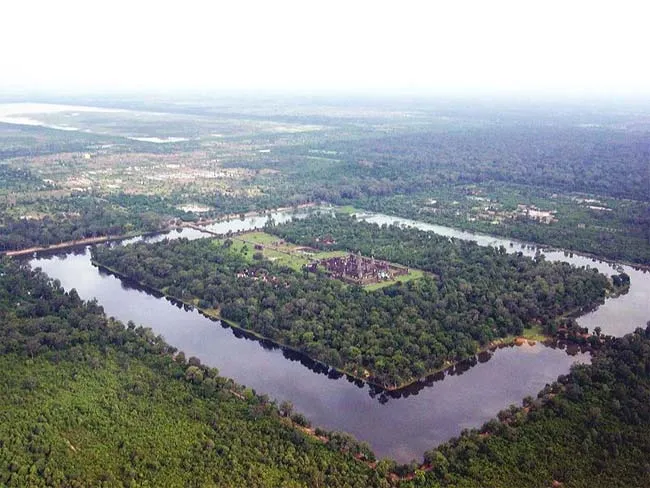
Climate change might have helped bring about the fall of the ancient Khmer civilization in Angkor, Cambodia, nearly 600 years ago, new research suggests.
Historians have given various explanations for the fall of the empire that stretched across much of Southeast Asia between the ninth and 14th centuries (801 to 1400), from land overexploitation to conflict with rival kingdoms. But the new study offers strong evidence that two severe droughts, punctuated by bouts of heavy monsoon rain, could have weakened the empire by shrinking water supplies for drinking and agriculture, and damaging Angkor's vast irrigation system, which was central to its economy.
The kingdom, one of the greatest civilizations of all time, is thought to have collapsed in 1431 after a raid by the Siamese from present-day Thailand.
"Angkor at that time faced a number of problems — social, political and cultural. Environmental change pushed the ancient Khmers to the limit and they weren't able to adapt," said study author Brendan Buckley, a climate scientist at Columbia University's Lamont-Doherty Earth Observatory in New York. "I wouldn't say climate caused the collapse, but a 30-year drought had to have had an impact."
The researchers were able to reconstruct 759 years of past climate in the region surrounding Angkor by studying the annual growth rings of cypress trees in a nearby national park. The tree rings revealed evidence of a mega-drought lasting three decades — from the 1330s to 1360s — followed by a more severe but shorter drought from the 1400s to 1420s, right before the empire collapse.
The droughts could have led to crop failure and a rise in infectious disease, and both problems would have been exacerbated by the density of the population, Buckley said.
They also found evidence for intense rainy seasons that might have damaged Angkor's hydraulic system. During a normal monsoon season, Angkor's vast network of canals, embankments and reservoirs could have handled heavy downpours, but after extended droughts, the system may have been vulnerable to clogging.
Get the world’s most fascinating discoveries delivered straight to your inbox.
The researchers suspect that El Niño, a cyclical warming of the tropical Pacific Ocean, might have played an important role in shutting down the monsoon rains in this region, leading to droughts.
"The evidence from monsoon Asia should remind us that complex civilizations are still quite vulnerable to climate variability and change," said study researcher Kevin Anchukaitis, also of Columbia University.
Similar studies suggest that abrupt environmental changes may have pushed other ancient civilizations over the edge, including the Anasazi people of the southwestern United States; the Maya people of Central America; and the Akkadian people of Mesopotamia.
The results were published this week in the journal Proceedings of the National Academy of Sciences.
- Top 10 Ways Weather Changed History
- Top 10 Events That Changed History
- History's Most Overlooked Mysteries
