













Milestone: 50 Percent of Fish Are Now Farmed

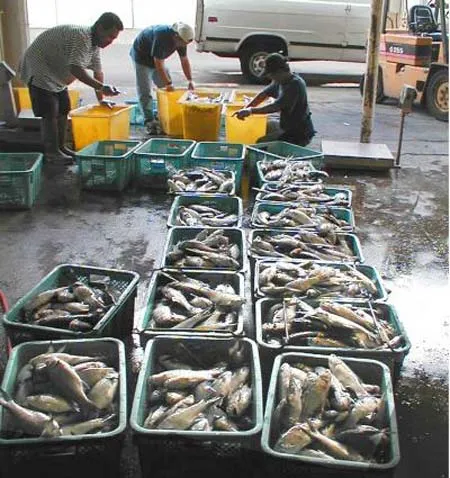
More and more fish are being raised on farms before they end up on dinner plates around the world. Aquaculture, or the culturing of fish in a controlled environment, now accounts for 50 percent of the fish consumed globally, a fact that's putting tremendous strain on wild fish.
The big downside to fish farming: It requires large amounts of feed made from wild fish harvested from the sea.
"It can take up to five pounds of wild fish to produce one pound of salmon, and we eat a lot of salmon," said lead author Rosamond L. Naylor, a professor of environmental Earth system science at Stanford University.
There are also concerns about spreading disease from farmed to wild fish.
Nonetheless, fish farming has grown rapidly in recent years, nearly tripling in volume between 1995 and 2007. Part of the reason for the rise is increased demand for omega-3 fatty acids, a type of fatty acid found in oily fish that is thought to be effective in reducing the risk of cardiovascular disease, according to the National Institutes of Health.
"The huge expansion is being driven by demand," Naylor said. "As long as we are a health-conscious population trying to get our most healthy oils from fish, we are going to be demanding more of aquaculture and putting a lot of pressure on marine fisheries to meet that need."
The study was published Sept. 7 in the online edition of the Proceedings of the National Academy of Sciences, and was funded by the David and Lucile Packard Foundation.
Get the world’s most fascinating discoveries delivered straight to your inbox.
Fish become fish food
In order to maximize growth and enhance flavor, aquaculture farms use large quantities of fishmeal and fish oil made from less valuable wild-caught species, including anchoveta (cousins to anchovies) and sardine. In fact, 88 percent of global fish oil consumption goes to aquacultures, the study says.
This adds up to quite a lot of fish being used for fish food. In 2006, about 22 million short tons (20 million metric tons) of wild fish were needed to produce 57 million short tons (51.7 million metric tons) of farmed fish.
One way to make salmon farming more environmentally sustainable is to simply lower the amount of fish oil in the salmon's diet. A 4 percent reduction in fish oil would reduce the amount of wild fish needed to produce 1 pound of salmon, from 5 pounds to 3.9 pounds (2.3 kg to 1.8 kg), according to the authors. In contrast, reducing fishmeal use by 4 percent would have very little environmental impact, they said.
Several fish-feed substitutes are also currently being investigated, such as protein made from grain and livestock byproducts and omega-3 oils extracted from genetically modified plants and single-cell microorganisms. The proper economic and regulatory incentives could accelerate the transition toward alternative feedstuffs, the authors say.
Vegetarian fish not so environmentally friendly
Fishmeal and fish oil are especially important for raising carnivorous fish, including salmon, trout and tuna. "Vegetarian" fish, on the other hand, can be raised on feed made from plants.
But it turns out that non-carnivorous fish, such as Chinese carp and tilapia, actually do consume quite a bit of fishmeal. In the early 1990's, vegetarian fish farms started adding fishmeal to their feeds to increase their yields. In 2007, tilapia and carp farms together consumed more than 13 million short tons (12 million metric tons) of fishmeal — more than 1.5 times the amount used by shrimp and salmon farms combined.
"Our assumption about farmed tilapia and carp being environmentally friendly turns out to be wrong in aggregate, because the sheer volume is driving up the demand," Naylor said. "Even the small amounts of fishmeal used to raise vegetarian fish add up to a lot on a global scale." Removing fishmeal from the diet of tilapia and carp would have a very positive impact on the marine environment, she added.
Changing policy
Several legislative acts call for the reduction of fishmeal and fish oil in feeds, including California's Sustainable Oceans Act and the proposed National Offshore Aquaculture Act.
There are also plans by the National Oceanographic and Atmospheric Administration to develop a comprehensive national policy that addresses fisheries management issues posed by aquaculture.
"No matter how much is done from the demand side, it is essential that there be regulation on the supply side as well," Naylor said. "You won't prevent the collapse of anchoveta, sardine and other wild fisheries unless those fisheries are carefully regulated."
- Video: Salmon Sickness Spreads
- Hate Fish? Try Grasses Instead for Omega-3s
- All About Fish
