













High Tides Raise Odds of Powerful Earthquakes

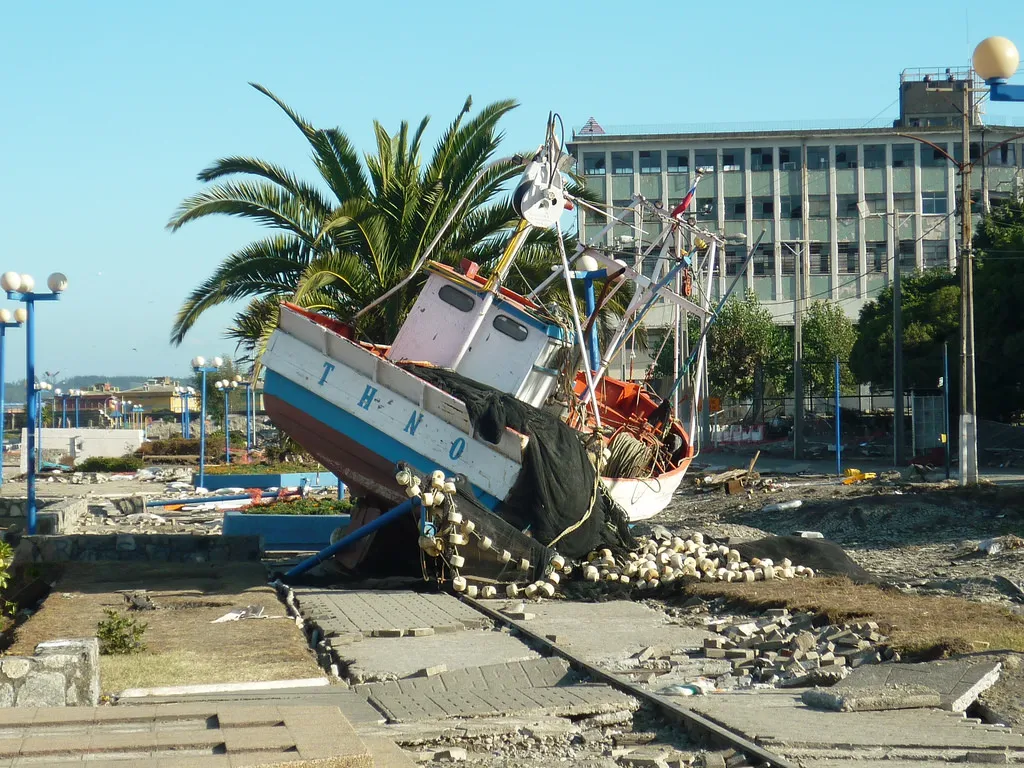
Gravitational forces that create high tides during full and new moons may also intensify tremors to the point that they become big earthquakes, according to a new study.
Ocean tides are caused primarily by the gravitational pull of the moon and sun on Earth. These same gravitational forces also strain geological faults, triggering both tremors and earthquakes, the researchers said.
Seismologists previously connected high tides to tremors along California's San Andreas fault. But now, a team of scientists has found larger patterns of tides and earthquakes. A review of the world's largest earthquakes revealed that the incidents tended to coincide with strong tides, when the moon was full or new and aligned with the sun, the scientists said. [Image Gallery: This Millennium's Destructive Earthquakes]
The researchers focused on large earthquakes of magnitude-5.5 or greater that occurred over the last two decades. By reconstructing the tidal stress, or gravitation pull, before the earthquakes, the scientists found that many of the largest earthquakes occurred when the tides were especially strong.
"We find that very large earthquakes … tend to occur near the time of maximum tidal stress amplitude," the researchers wrote in their study. "This tendency is not obvious for small earthquakes."
The researchers found that of the more than 10,000 earthquakes studied, the tremors that began during high tidal stress were more likely to develop into a magnitude-8 or above megaquake.
Both the destructive 2004 Indonesia earthquake, a magnitude-9.1 temblor that killed 280,000 people, and the magnitude-8.8 earthquake that struck Chile in 2010, killing more than 500 people and raising the coastline, occurred around a full moon and near-peak tidal stress, the researchers said.
Get the world’s most fascinating discoveries delivered straight to your inbox.
How large earthquakes begin and evolve is still not fully understood, the researchers noted. One hypothesis suggests a cascading process, in which all earthquakes begin with a tiny fracture. Based on this theory, the researchers propose that high tidal stress corresponds to the growth of the cascading ruptures, leading to large-scale quakes.
Earthquakes of less than magnitude 3 occur every day, and are generally not felt by people, according to the National Earthquake Information Centerwhile magnitude-8 earthquakes occur globally just once a year, on average, and can be highly destructive. Given the rarity of such events, these megaquakes are difficult to predict. However, the results of this new study could lead to better earthquake forecasting, the researchers said.
"[K]nowledge of the tidal stress state in seismic regions can be used to improve probabilistic earthquake forecasting, especially for extremely large earthquakes," Ide and his colleagues wrote in the paper.
Their detailed findings were published online yesterday (Sept. 12) in the journal Nature Geoscience.
Original article on Live Science.
