 Live Science Plus





You are now subscribed
Your newsletter sign-up was successful
Want to add more newsletters?

Delivered Daily
Daily Newsletter
Sign up for the latest discoveries, groundbreaking research and fascinating breakthroughs that impact you and the wider world direct to your inbox.

Once a week
Life's Little Mysteries
Feed your curiosity with an exclusive mystery every week, solved with science and delivered direct to your inbox before it's seen anywhere else.

Once a week
How It Works
Sign up to our free science & technology newsletter for your weekly fix of fascinating articles, quick quizzes, amazing images, and more

Delivered daily
Space.com Newsletter
Breaking space news, the latest updates on rocket launches, skywatching events and more!

Once a month
Watch This Space
Sign up to our monthly entertainment newsletter to keep up with all our coverage of the latest sci-fi and space movies, tv shows, games and books.

Once a week
Night Sky This Week
Discover this week's must-see night sky events, moon phases, and stunning astrophotos. Sign up for our skywatching newsletter and explore the universe with us!
Join the club
Get full access to premium articles, exclusive features and a growing list of member rewards.
Some beetles play possum, and for the same reason that possums do: to avoid attention from predators. A new study highlights the reason for the trick's success—it works by sacrificing the neighbors.
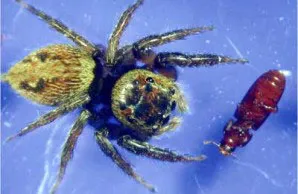
Takahisa Miyatake of Okayama University in Japan has long studied the red flour beetle, Tribolium castaneum, and its spider predator, Adanson's house jumper, Hasarius adansoni. When a spider attacks, the beetle feigns death by entering a state known as tonic immobility, which often averts real death.
To figure out exactly why the tactic succeeds, Miyatake and three colleagues bred one beetle strain that feigns death for about twenty minutes and one that doesn't do it at all. Then they studied interactions between spiders and beetles of both strains.
Spiders prefer living prey, so they were less likely to devour beetles that feigned death after an attack, the researchers found. That was especially true if alternative prey was available. Spiders ate death-feigning beetles 38 percent of the time when the beetles were alone, but if the spider had a choice between a death-feigner and a nonfeigner, it bagged the nonfeigner almost every time. The results were comparable when spiders had a choice of death-feigning red flour beetles and nonfeigning beetles of a different species.
The researchers conclude that tonically immobile beetles enjoy improved odds of survival, especially when in the company of more mobile compatriots.
The findings were detailed in the journal Proceedings of the Royal Society B.
- Secret Weapons: 10 Creative Insect Defenses
- A No Brainer: Predators Prefer Dimwitted Prey
- Spider News, Images & Information
