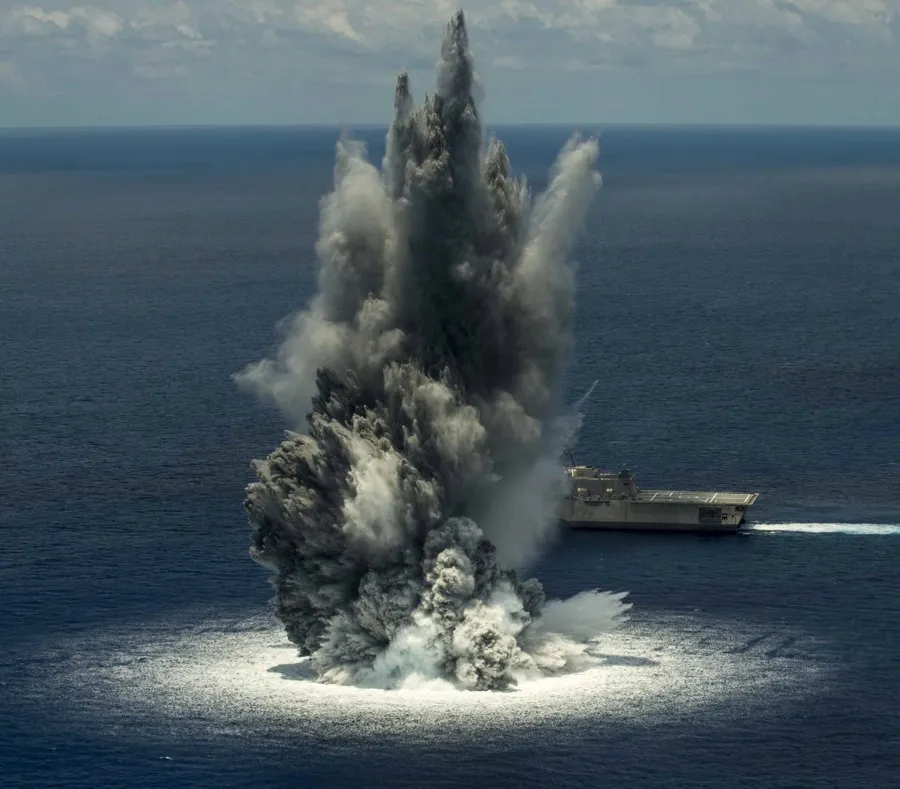
A tremor reported on July 16 off the coast of Florida was not an earthquake, but a Naval test explosion.
The U.S. Geological Survey now lists the event on its earthquake hazards page as an "experimental explosion by the U.S. Navy." According to DefenseNews.com, the 10,000-pound explosion was set off to test the resilience of a combat ship, the USS Jackson. Navy officials have told multiple news outlets that they plan to release a statement about the testing.
USGS instruments measured the blast as a magnitude-3.7 earthquake, which would have been a rare seismic event in the tectonically quiet region. Florida sits on the passive margin of the North American continental plate, meaning that temblors are rare. The active margin of the plate is on the West Coast, where the North American plate is slipping under the Pacific plate in a process called subduction. Subduction is why California and the Pacific Northwest experience earthquakes on a relatively regular basis.
Latest Videos From
There has never been an earthquake with its epicenter under Florida, according to the state's Department of Environmental Protection. On occasion, Floridians have felt tremors from quakes centered outside of the state. For example, in September 1886, Florida experienced some shaking from a massive earthquake in Charleston, South Carolina, which had an estimated magnitude of 7.3, according to the USGS. It was the most damaging earthquake ever in the Southeast, according to the agency, and was unusual in that it occurred within a tectonic plate, not at the boundary between two plates.
Scientists don't yet understand why earthquakes sometimes occur within plates, according to the Incorporated Research Institutes for Seismology, a consortium of universities that gathers seismological data.
The Florida Navy test, which took place 104 miles (168 kilometers) east-northeast of Daytona Beach, is not the first non-earthquake mistaken for a temblor. A 1997 review of all of Florida's historical earthquake reports suggests that out of about 24 incidents reported since 1727, only about five were probably actual quakes.
Many of the events, rounded up in a 1991 report, are poorly sourced or can't be confirmed. For example, in 1948, people on Captiva Island reported rattling doors and the sound of distant explosions. In 1952, a slight tremor rattled doors and windows in Quincy, Florida. Such rattling could be explained by ground tremors, but small shakes are also caused by construction, explosions and even supersonic flight (first developed in 1948). And though deep freeze is rare in Florida, some colder areas have reported small earthquakes that are actually "frostquakes" — groundwater expanding rapidly in a deep freeze, causing booming sounds and localized shaking.
Original article on Live Science.