 Live Science Plus





You are now subscribed
Your newsletter sign-up was successful
Want to add more newsletters?

Delivered Daily
Daily Newsletter
Sign up for the latest discoveries, groundbreaking research and fascinating breakthroughs that impact you and the wider world direct to your inbox.

Once a week
Life's Little Mysteries
Feed your curiosity with an exclusive mystery every week, solved with science and delivered direct to your inbox before it's seen anywhere else.

Once a week
How It Works
Sign up to our free science & technology newsletter for your weekly fix of fascinating articles, quick quizzes, amazing images, and more

Delivered daily
Space.com Newsletter
Breaking space news, the latest updates on rocket launches, skywatching events and more!

Once a month
Watch This Space
Sign up to our monthly entertainment newsletter to keep up with all our coverage of the latest sci-fi and space movies, tv shows, games and books.

Once a week
Night Sky This Week
Discover this week's must-see night sky events, moon phases, and stunning astrophotos. Sign up for our skywatching newsletter and explore the universe with us!
Join the club
Get full access to premium articles, exclusive features and a growing list of member rewards.
You might have heard of vagina dentata — the mythical "toothed vagina" born of male paranoia. But have you heard of the carnivorous penis-shaped worm known as Ottoia prolifica? This 505-million-year-old phallus-like creature actually had a throat full of teeth.
Now, scientists who took a close look at the teeth of fossilized penis worms (or priapulids) have discovered a new species.

At just a few inches long, O. prolifica lived inside burrows and had a proboscis that was lined with rows of little hooks, teeth and spines. This mouthpart could be inverted into the creature's trunk (as this animation from the Royal Ontario Museum shows), and it allowed O. prolifica to feast on shelled creatures known as hyolithids (although O. prolifica may also have occasionally cannibalized other penis worms), according to the Smithsonian National Museum of Natural History.
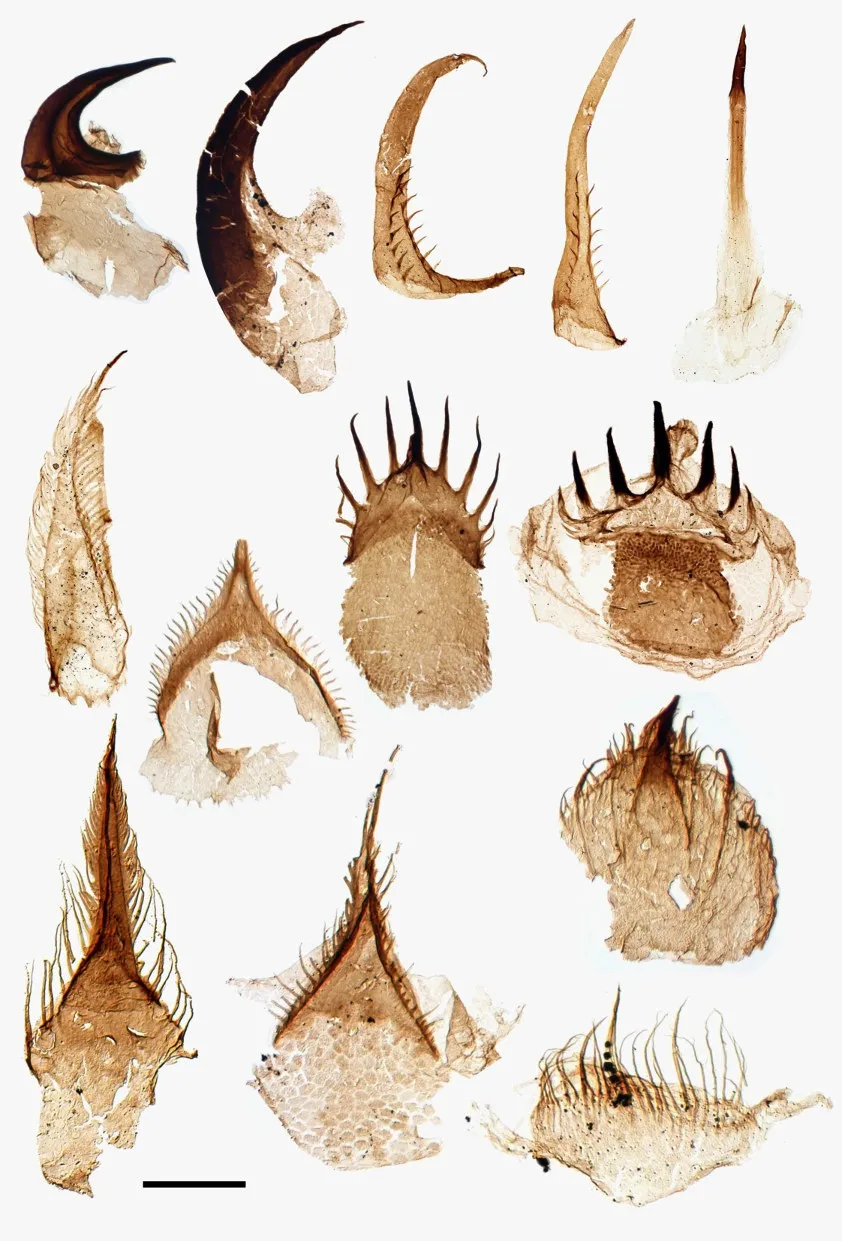
In a new report, researchers led by Martin Smith of the University of Cambridge in England created a "dentist's handbook" of O. prolifica teeth. Under a microscope, they looked at 40 O. prolifica fossils from a location called the Upper Walcott Quarry that are now in a collection at the Smithsonian Institution, and 70 other specimens from the Lower Walcott Quarry that are housed in the Royal Ontario Museum.
The researchers found some unexpected differences between the teeth in the two groups of fossils. For example, the specimens from the Lower Walcott Quarry had some teeth with a central prong that was flanked by just two skinny, hollow "denticles," whereas up to eight denticles were common in the corresponding teeth of the Upper Walcott Quarry specimens.
Those slight differences would be enough for scientists to declare a new species among modern priapulids, so Smith and his colleagues said the fossils from the Lower Walcott Quarry represent a distinct species, which they named O. tricuspida.
The findings were published in the journal Palaeontology today (May 6).
Follow Megan Gannon on Twitter. Follow us @livescience, Facebook & Google+. Original article on Live Science.

