













Bizarre Condition Makes Tongue Resemble a Geographic Map

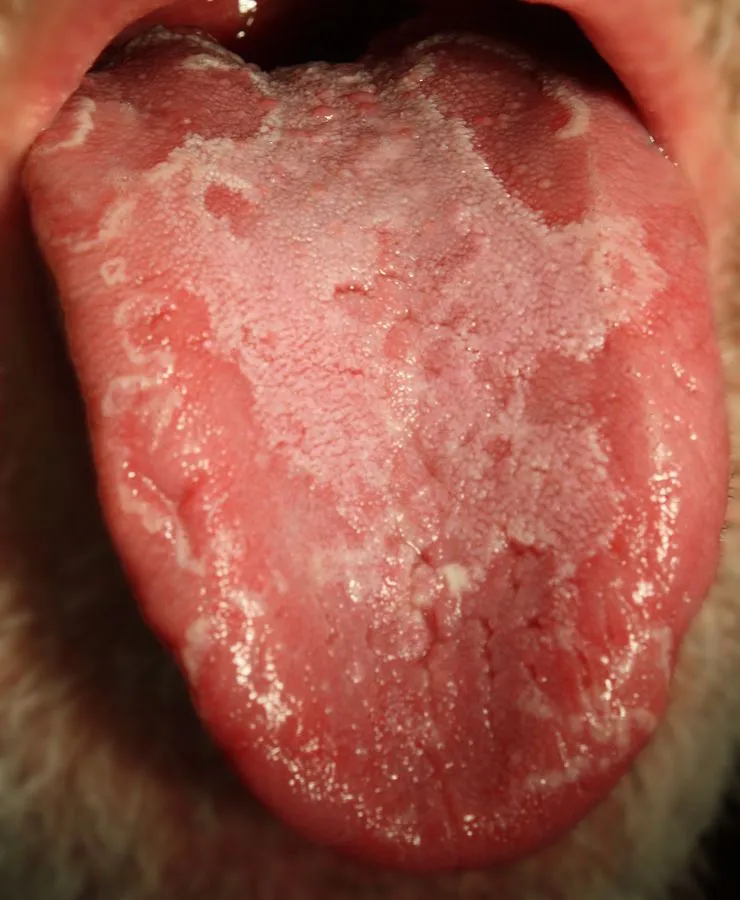
A mysterious condition that gives the tongue a mottled appearance that can sometimes resemble a map of the continents has long baffled scientists, but new research may offer some clues to its causes.
Known as "geographic tongue," the condition causes red, patchy shapes to appear on the tongue, formed as some areas lose the tiny reddish bumps called papillae that normally cover the tongue's surface. The condition is harmless for the people who have it, but it is chronic, and affects about 2 percent of the population.
Now, researchers in Israel have discovered that there are two forms of the condition, and that each form spreads differently over the tongue. The findings, described Wednesday (April 1) in the New Journal of Physics, could lead to practical tools for diagnosing the condition, the researchers say. [The 9 Most Bizarre Medical Conditions]
Geographic tongue (GT) affects the tongue's upper layer of tissue, call the epithelium. This layer includes the bumpy papillae, which contain the taste buds. In people with GT, one type of papillae called filiform papillae becomes inflamed, said study co-author Gabriel Seiden, a physicist at the Weizmann Institute of Science in Israel, who is currently based at the Max Planck Institute for the Physics of Complex Systems in Germany.
In the study, Seiden and his colleagues use math equations to explain what happens in geographic tongue. They treated the tongue as a system through which "waves" of a certain state can pass, like a wildfire passing through a forest.
"When this flame grows," he said, "it essentially destroys this layer, and continues until the whole forest is burned down," or the entire tongue is affected. Eventually, the tongue heals by itself, but since the disease is chronic, the process eventually repeats itself.
The researchers found that in people with one form of GT, the condition starts out as a series of small spots that expand gradually in a circular pattern. Just as a fire cannot return to a burned spot until the vegetation has regrown, the inflammation doesn't return to places it has already been.
Get the world’s most fascinating discoveries delivered straight to your inbox.
But in people with the other form of the condition, the patches develop in spiral patterns that can move into parts of the tongue that are still healing, causing repeated tongue inflammation that can linger for a long time, the researchers said. This form is more often seen in adults than in children, Seiden said.
The researchers also studied a 1-year-old boy with geographic tongue who developed the patches along the edge of his tongue nearest to his growing teeth, suggesting that the condition in his case could have been caused by the rubbing action of the tongue against the gum.
People with GT may have mild pain or irritation, but the condition is not otherwise harmful, Seiden said. There are some prescription medications available, but they mainly treat the condition's symptoms.
Seiden said he hopes the findings will increase the scientific understanding of the condition, and possibly help doctors identify its different forms.
Geographic tongue was first reported around the 1830s, but despite extensive study, medical experts still don't know exactly what causes it. However, it may be associated with the skin condition psoriasis, which is thought to be triggered by an overactive immune system, Seiden said.
Follow Tanya Lewis on Twitter. Follow us @livescience, Facebook & Google+. Original article on Live Science.
