 Live Science Plus





You are now subscribed
Your newsletter sign-up was successful
Want to add more newsletters?

Delivered Daily
Daily Newsletter
Sign up for the latest discoveries, groundbreaking research and fascinating breakthroughs that impact you and the wider world direct to your inbox.

Once a week
Life's Little Mysteries
Feed your curiosity with an exclusive mystery every week, solved with science and delivered direct to your inbox before it's seen anywhere else.

Once a week
How It Works
Sign up to our free science & technology newsletter for your weekly fix of fascinating articles, quick quizzes, amazing images, and more

Delivered daily
Space.com Newsletter
Breaking space news, the latest updates on rocket launches, skywatching events and more!

Once a month
Watch This Space
Sign up to our monthly entertainment newsletter to keep up with all our coverage of the latest sci-fi and space movies, tv shows, games and books.

Once a week
Night Sky This Week
Discover this week's must-see night sky events, moon phases, and stunning astrophotos. Sign up for our skywatching newsletter and explore the universe with us!
Join the club
Get full access to premium articles, exclusive features and a growing list of member rewards.
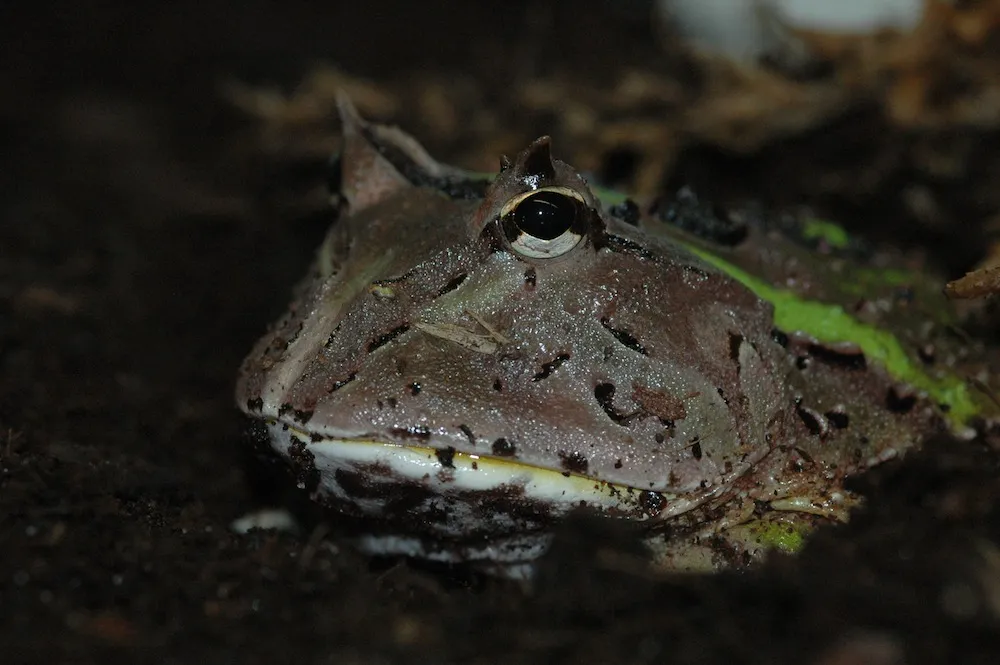
Horned frogs are capable of consuming prey that are very large relative to the amphibians' own bodies, and they may be able to pull off this impressive feat thanks to the strength of their tongues, new research suggests.
When the frogs catapult their tongues to catch a hapless creature, the organ's adhesive forces exceed the weight of the animals' prey, and sometimes even the frog's own body weight, according to the study detailed today (June 12) in the journal Scientific Reports.
"The attachment to the prey must at least be strong enough to prevent the prey from escaping before it is grasped by the jaws — depending on the size of the prey, it will even be lifted off the ground and actively pulled into the mouth of the frog," the researchers wrote in the study.
Many frogs have sticky, mucus-laden tongues that can reel prey into the animals' mouths. But until now, scientists didn't understand how strong the tongues were, how they attach or what role the mucus plays.
In the study, Thomas Kleinteich, a biologist at Christian-Albrechts-Universität-Kiel in Germany, and his colleagues measured the tongue stickiness of captive horned frogsof the group Ceratophryidae, which are native to Argentina, Bolivia, Brazil and Paraguay. These frogs are known to sit and wait for their prey, which include lizards, snakes, rodents, earthworms, spiders, insects and other frogs.
The researchers got the frogs to fire their tongues at a pressure-sensitive glass panel by placing prey on the other side. Results showed that the pulling forces were about three times the frogs' body weight, and in the case of one frog, as much as six times its weight.
The strength of the forces increased when the impact was high-pressure and lasted only a short time, the researchers said. Most tongue impacts were lightning-fast, averaging less than 40 milliseconds.
The strength of adhesion increased with lower levels of mucus coverage in the contact region, which suggests the mucus doesn't act like glue. Rather, the tongue surface itself seems to determine adhesiveness, though the mucus may increase surface friction, the researchers said.
The tongue stickiness measured in the study was most comparable to pressure-sensitive adhesives used for tapes or labels, the researchers said.
However, the glass surface could have different adhesive properties from surfaces in the frogs' natural habitat, such as fur, feathers or leaf surfaces, the researchers said.
Previously, scientists have only measured the stickiness of salamander tongues, and found these forces were only a fraction of the creatures' bodyweights. In contrast to salamanders, which rely on firing their tongue skeletons out of their mouths, frogs project their tongues by rapidly dropping their lower jaws. The two animals are thought to have evolved their tongue ballistics independently, the researchers said.
Editor's Note: If you have an amazing frog or amphibian photo you'd like to share for a possible story or image gallery, please contact managing editor Jeanna Bryner at LSphotos@livescience.com.
Follow Tanya Lewis on Twitter and Google+. Follow us @livescience, Facebook & Google+. Original article on Live Science.

