













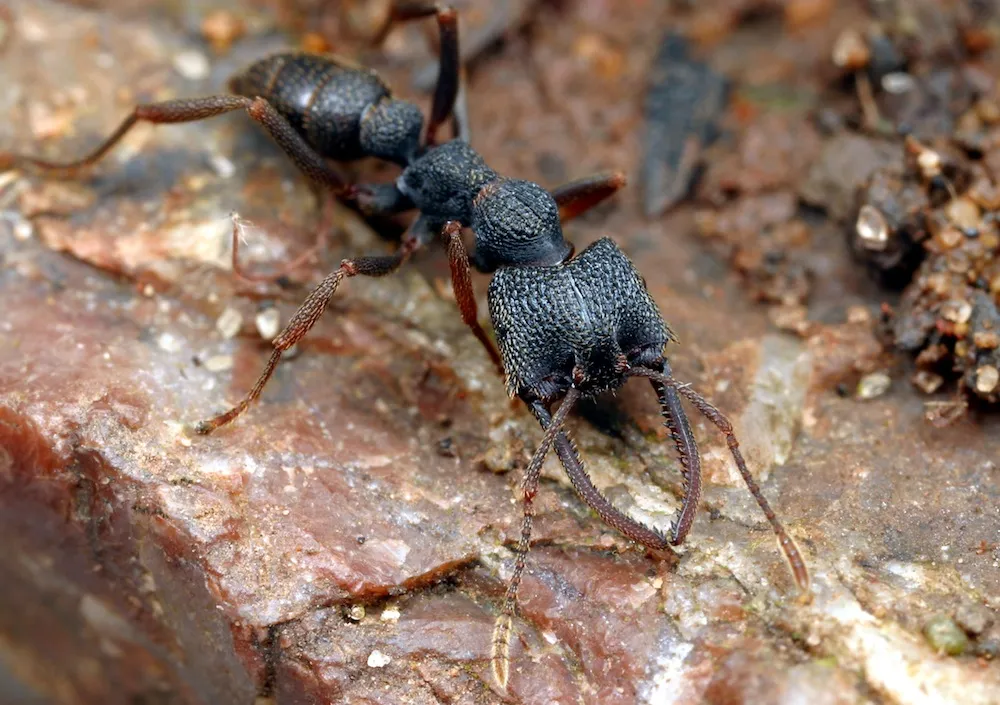
Six new species of a mysterious blood-sucking ant have been identified in Madagascar — and they're an especially odd bunch.
The so-called Dracula ants, described today (March 31) in the journal ZooKeys, seem to defy many of the normal rules that scientists use to classify ants.
"The genus Mystrium is the most mysterious group within the bizarre Dracula ants," study co-author Masashi Yoshimura, a researcher at the California Academy of Sciences, said in a statement. "Mystrium was a difficult group to identify because of the remarkable variation within each species."
The new species include the Mystrium labyrinth, the Mystrium mirror and the Mystrium shadow. [Mind Control: See Photos of Zombie Ants]
Nonconformists
Dracula ants, so named because they suck the blood of their young in a process dubbed "nondestructive cannibalism," were first discovered in a rotting log in Madagascar more than a decade ago.
But for years, these weird insects confounded researchers, as looks can be deceiving for the Dracula ants.
Get the world’s most fascinating discoveries delivered straight to your inbox.
"The role of an individual in a colony is not always obvious by its appearance. Ants that look similar may be minor workers in one species but queens in another species," study co-author Brian Fisher, an entomologist at the California Academy of Sciences, said in a statement.
For instance, the workers sometimes become queen ants; the queens may have short, nonexistent or large wings; and the queens can often be smaller than the workers. In addition, the genus had three different modes of reproduction, making classification even more difficult.
Mystery solved
After collecting and scrutinizing thousands of the ants in Madagascar for two decades, Yoshimura and Fisher figured out a method for distinguishing new species.
It turned out the ants start out as either a male, a large queen or a major or minor worker, Yoshimura said. Though some of the workers may then go on to reproduce or even become queens, identifying the species requires knowing these origin states, not the current role, of the ant. Classifying them also requires understanding their reproductive style.
Using this new framework, the researchers were able to reclassify several existing species and identify six completely new ones.
Follow Tia Ghose on Twitter and Google+. Follow Live Science @livescience, Facebook & Google+. Original article on Live Science.

Tia is the editor-in-chief (premium) and was formerly managing editor and senior writer for Live Science. Her work has appeared in Scientific American, Wired.com, Science News and other outlets. She holds a master's degree in bioengineering from the University of Washington, a graduate certificate in science writing from UC Santa Cruz and a bachelor's degree in mechanical engineering from the University of Texas at Austin. Tia was part of a team at the Milwaukee Journal Sentinel that published the Empty Cradles series on preterm births, which won multiple awards, including the 2012 Casey Medal for Meritorious Journalism.