 Live Science Plus





You are now subscribed
Your newsletter sign-up was successful
Want to add more newsletters?

Delivered Daily
Daily Newsletter
Sign up for the latest discoveries, groundbreaking research and fascinating breakthroughs that impact you and the wider world direct to your inbox.

Once a week
Life's Little Mysteries
Feed your curiosity with an exclusive mystery every week, solved with science and delivered direct to your inbox before it's seen anywhere else.

Once a week
How It Works
Sign up to our free science & technology newsletter for your weekly fix of fascinating articles, quick quizzes, amazing images, and more
Delivered daily
Space.com Newsletter
Breaking space news, the latest updates on rocket launches, skywatching events and more!

Once a month
Watch This Space
Sign up to our monthly entertainment newsletter to keep up with all our coverage of the latest sci-fi and space movies, tv shows, games and books.

Once a week
Night Sky This Week
Discover this week's must-see night sky events, moon phases, and stunning astrophotos. Sign up for our skywatching newsletter and explore the universe with us!
Join the club
Get full access to premium articles, exclusive features and a growing list of member rewards.
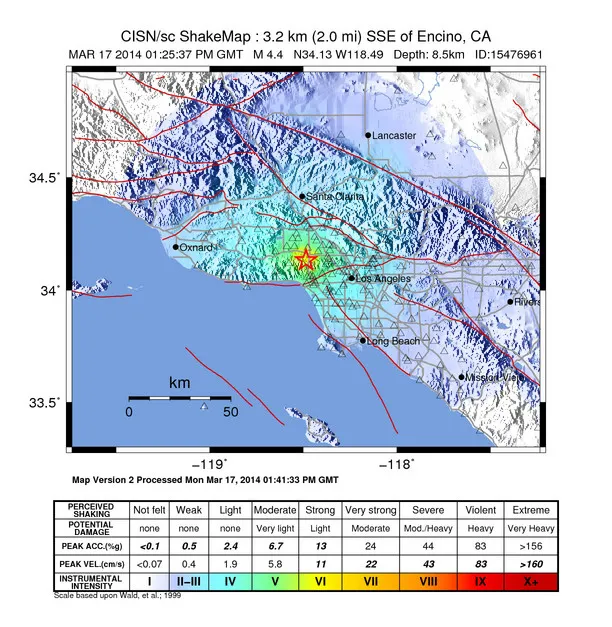
An earthquake of preliminary magnitude 4.4 struck this morning in Los Angeles, according to the U.S. Geological Survey (USGS).
Shaking was felt across the region as far south as Riverside and as far north as San Clemente, Calif. There were no immediate reports of damage, the Los Angeles Times reports.
The earthquake's epicenter was 2 miles (3 kilometers) north of Sherman Oaks, Calif. The quake was centered 6 miles (10 km) from Beverly Hills, 7 miles (11 km) from Universal City and 7 miles (11 km) from Santa Monica, according to the USGS.
It originated 5 miles (8 km) deep and struck at 6:25 a.m. local time (13:25 p.m. UTC) Monday (March 17), according to the USGS. Preliminary information suggests it was on a strike-slip fault, where two blocks on either side of a fault move horizontally past one another.
Earthquakes of this size tend to be felt by people in the area but typically do not cause significant damage, other than possibly broken windows and falling dishes or the toppling of unstable objects. But the damage caused by any single event depends on the quake's depth, proximity to populated areas, building standards in the region, as well as the type of earthquake. The USGS frequently updates the magnitude of an event after more data is analyzed.
But the damage caused by any single event depends on the quake's depth, proximity to populated areas, building standards in the region, as well as the type of earthquake. The USGS frequently updates the magnitude of an event after more data is analyzed.
An earthquake's magnitude is a measure of the energy released at the source. It is just one predictor of the shaking that may ensue, which is affected by local and regional geology. Scientists know in a general sense what causes earthquakes but are unable to predict specific quakes.
This article will be updated if significant additional information becomes available. Find more earthquake news here.

