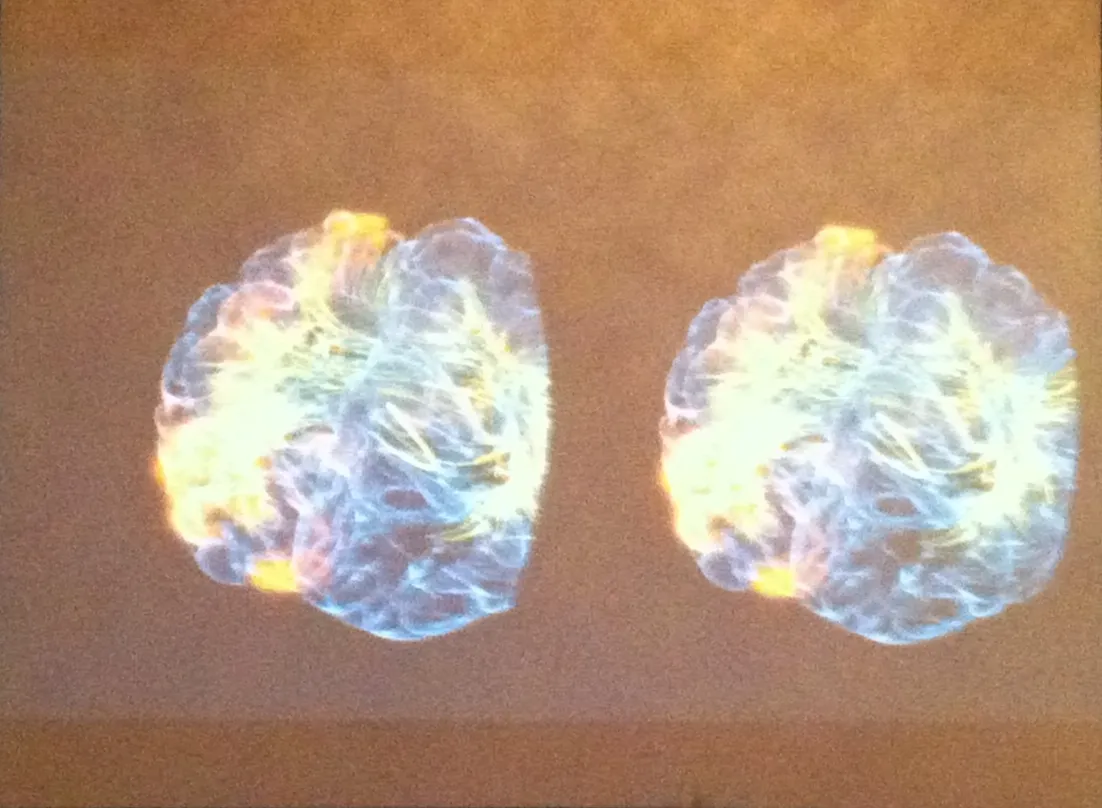
Philip Rosedale, creator of the game Second Life, and Adam Gazzaley, a neuroscientist at the University of California San Francisco, demonstrated their "glass brain" here at the South by Southwest (SXSW) Interactive festival on March 10, 2014. Here, the interior of Rosedale's wife's brain in real-time on a projector screen.
AUSTIN, Texas — What if it were possible to explore your brain in virtual reality, watching your thoughts flashing before your eyes? A team of neuroscientists and software developers have created a way to do precisely that.
A new system combines brain scanning, brain recording and virtual reality to allow a user to journey through a person's brain in real-time. This "glass brain" was demonstrated here at the South by Southwest (SXSW) Interactive festival today (March 10).
The system was developed bycomputational neuroscientists Tim Mullen and Christian Kothe of the University of California, San Diego, in collaboration with the lab of Adam Gazzaley, a neuroscientist at the University of California, San Francisco, using a virtual reality headset made by the gaming company Oculus Rift.
"We've never been able to step inside the structures [of the brain] and see it in this way," Gazzaley said. "It's biofeedback on the next level."
Independently, Gazzaley has been collaborating with Philip Rosedale, creator of the game Second Life, on using virtual reality to improve neuroscience, and vice versa.
The brain in the demo actually belonged to Rosedale's wife Yvette, who was wearing a cap studded with electroencephalogram (EEG) electrodes that measure differences in electric potential in order to record brain activity. Gazzaley's team had previously scanned Yvette's brain using magnetic resonance imaging (MRI) to reveal its underlying structure and tangle of neural fibers. [3D Images: Exploring the Human Brain]
A new system called "glass brain" reveals the surface of a woman's brain in real-time. The system, which uses virtual reality, brain scanning and brain recording, was demonstrated at the South by Southwest Interactive festival on March 10, 2014.
(Image credit: Tanya Lewis for Live Science)
During the demo, Rosedale wore a virtual reality headset through which he could explore his wife's brain in 3D, as flashes of light displayed her brain activity from the EEG. A projection screen showed a similar view to the audience. When the brain came on the screen, the buzz of excitement in the room was audible.
Sign up for the Live Science daily newsletter now
Get the world’s most fascinating discoveries delivered straight to your inbox.
The glass brain didn't actually show what Yvette was thinking — the EEG signals merely painted a picture of her brain activity more broadly. But the researchers ultimately hope to get closer to decoding brain signals and displaying them using the virtual reality system.
Being able to literally watch your own brain activity is not only fun, it has therapeutic potential. For example, people with traumatic brain injury or other neurological problems could visualize how their condition is affecting their brain activity, and learn to correct it.
So far, the team has focused on visualizing one brain at a time. But Philip Rosedale foresees a day when two people could interact virtually in a way that telegraphs their inner state.
People often speak of interactions in virtual reality as being impoverished compared with those in the real world, Rosedale said. But, he asked, what if you could communicate in virtual reality in a way that makes real life impoverished?
Editor's note: This story was updated at 9:45 a.m. EDT on March 11 to correctly state each researcher's role in developing the technology.
Tanya was a staff writer for Live Science from 2013 to 2015, covering a wide array of topics, ranging from neuroscience to robotics to strange/cute animals. She received a graduate certificate in science communication from the University of California, Santa Cruz, and a bachelor of science in biomedical engineering from Brown University. She has previously written for Science News, Wired, The Santa Cruz Sentinel, the radio show Big Picture Science and other places. Tanya has lived on a tropical island, witnessed volcanic eruptions and flown in zero gravity (without losing her lunch!). To find out what her latest project is, you can visit her website.