 Live Science Plus





You are now subscribed
Your newsletter sign-up was successful
Want to add more newsletters?

Delivered Daily
Daily Newsletter
Sign up for the latest discoveries, groundbreaking research and fascinating breakthroughs that impact you and the wider world direct to your inbox.

Once a week
Life's Little Mysteries
Feed your curiosity with an exclusive mystery every week, solved with science and delivered direct to your inbox before it's seen anywhere else.

Once a week
How It Works
Sign up to our free science & technology newsletter for your weekly fix of fascinating articles, quick quizzes, amazing images, and more

Delivered daily
Space.com Newsletter
Breaking space news, the latest updates on rocket launches, skywatching events and more!

Once a month
Watch This Space
Sign up to our monthly entertainment newsletter to keep up with all our coverage of the latest sci-fi and space movies, tv shows, games and books.

Once a week
Night Sky This Week
Discover this week's must-see night sky events, moon phases, and stunning astrophotos. Sign up for our skywatching newsletter and explore the universe with us!
Join the club
Get full access to premium articles, exclusive features and a growing list of member rewards.
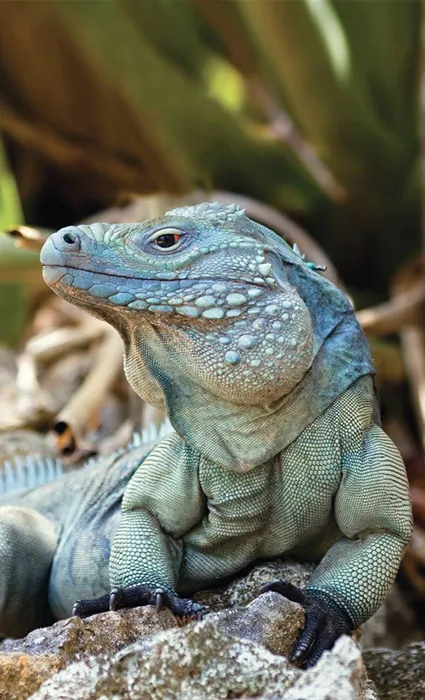
Iguanas have the oldest known sex chromosomes in the reptilian world, according to a new report.
Sex chromosomes are the gene-carrying structures in cells that determine the sex of an organism. Some groups of animals, such as mammals and birds, pass down their sex chromosomes within evolutionary lineages and do not experience much variability as new species evolve through time. But other animals, such as reptiles, generally experience more genetic variability in sex chromosomes as new species evolve.
Now, researchers based in the Czech Republic have conducted genetic studies that show iguanas do not follow this reptilian trend of high turnover rates for sex chromosomes. Instead, the majority of iguana species that have ever existed — estimated to be more than 1,000 species — have all shared the same sex chromosomes inherited from a common ancestor dating back to the Cretaceous Period, roughly 140 million years ago.
Since the Cretaceous, iguana species have evolved to live in wide-ranging regions of the world, from South America to Madagascar, and have adapted to habitats as varied as deserts and rainforests. Even so, these reptiles have maintained these same ancient chromosomes. [In Photos: The Wacky Animals of Madagascar]
"That's quite a nice conservation for such a long time," study co-author Lukas Kratochvil, a researcher at Charles University in Prague, told Live Science. "Dinosaurs went extinct, mammals started to be a successful group, and all iguanas still have the same sex chromosomes."
Kratochvil was surprised to find this long-term persistence of the chromosomes, since nothing on this timescale had ever been found in reptiles or other cold-blooded vertebrates.
"It is believed that reptiles have rapid turnover of sex chromosomes, and it was believed before our work that no such thing could be found in exothermic animals," Kratochvil said, referring to low turnover rates. Exothermic is another word for cold-blooded. "It really was a surprise to me."
A select few iguana species did show differences in their sex chromosomes, but more work is needed to understand this deviation from the trend, Kratochvil said.
This chromosome conservation may be more common amongst other reptiles, fish and amphibians than previously thought, Kratochvil said. Identifying variations in sex chromosomes requires detailed genetic work that has yet to be applied to a range of cold-blooded animal groups.
The team now plans to use similar techniques to examine the sex chromosomes of other reptiles, including geckos, snakes and other types of lizards. Through this research, the scientists hope to determine how common this phenomenon of sex chromosome conservation might be amongst other cold-blooded animals, Kratochvil said.
The study findings are detailed today (March 4) in the journal Biology Letters.
Follow Laura Poppick on Twitter. Follow us @livescience, Facebook & Google+. Original article on Live Science.

