













Owlets Sleep Like Human Babies

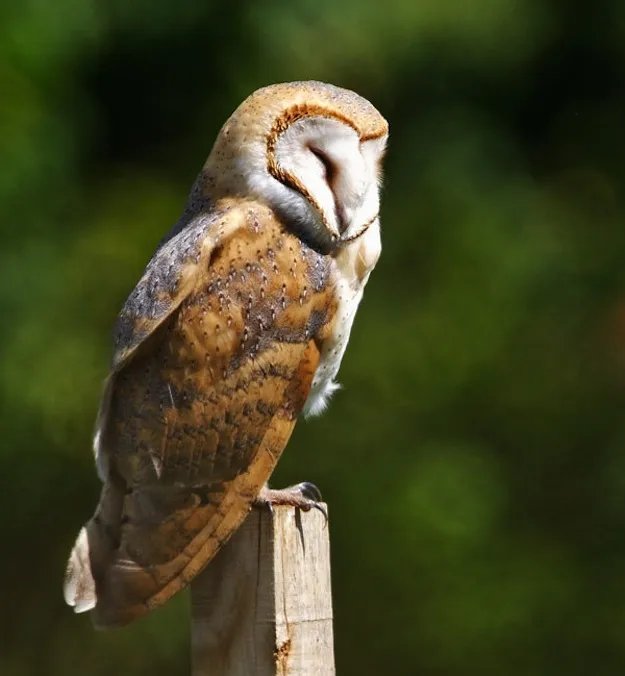
Rock-a-bye owlet, in the treetop …
Baby owls and baby mammals, including humans, sleep in an analogous manner, spending a similar amount of time in an awakelike phase called REM (rapid-eye movement), in which dreams are thought to occur, at least during adulthood, new research suggests.
In both owls and humans, REM sleep decreases with increasing age. Baby humans spend about 50 percent of their snooze time in this REM phase, whereas that figure decreases to less than 25 percent in adults, according to a statement from the Max Planck Institute for Ornithology. (Applying the REM term to owls, whose eyes are fixed in their heads, may seem a stretch, but researchers use the phrase anyway.)
In the new study, published in July in the journal Frontiers in Zoology, the researchers attached electroencephalograms (EEGs) and movement data loggers to 66 young barn owls to record how much time the animals spent in REM sleep and how much they moved while snoozing. They later removed the EEGs, which measure brain waves, and found that the birds mated normally and didn't appear to have suffered any negative effects from the devices, the statement noted. [7 Ways Animals Act Like Humans]
"During this sleep phase, the owlets' EEG showed awakelike activity, their eyes remained closed, and their heads nodded slowly," said University of Lausanne researcher Madeleine Scriba in the statement.
Whether the baby owls are dreaming is an open question, the researchers say. Studies suggest that human babies don't dream much, at least in the first few years of life. REM sleep during this time period is thought to play an important role in brain development and the acquisition of language.
The study researchers also found the owls that spend less time in REM sleep are more likely to express (or make proteins with) a gene linked to dark feather spots. Scientists aren't sure why there would be a link between feathers and REM sleep, but the finding could help explain why owls and other birds that have different colorations and markings often have other associated quirks, like dissimilar behaviors. Male barn owls with large spots, for example, seem to have less reproductive success than those with smaller spots.
Get the world’s most fascinating discoveries delivered straight to your inbox.
Email Douglas Main or follow him on Twitter or Google+. Follow us @livescience, Facebook or Google+. Article originally on LiveScience.
