Live Science Plus





You are now subscribed
Your newsletter sign-up was successful
Want to add more newsletters?

Delivered Daily
Daily Newsletter
Sign up for the latest discoveries, groundbreaking research and fascinating breakthroughs that impact you and the wider world direct to your inbox.

Once a week
Life's Little Mysteries
Feed your curiosity with an exclusive mystery every week, solved with science and delivered direct to your inbox before it's seen anywhere else.

Once a week
How It Works
Sign up to our free science & technology newsletter for your weekly fix of fascinating articles, quick quizzes, amazing images, and more
Delivered daily
Space.com Newsletter
Breaking space news, the latest updates on rocket launches, skywatching events and more!
Once a month
Watch This Space
Sign up to our monthly entertainment newsletter to keep up with all our coverage of the latest sci-fi and space movies, tv shows, games and books.

Once a week
Night Sky This Week
Discover this week's must-see night sky events, moon phases, and stunning astrophotos. Sign up for our skywatching newsletter and explore the universe with us!
Join the club
Get full access to premium articles, exclusive features and a growing list of member rewards.
A living time capsule of sorts has been found buried under hundreds of feet of Antarctic ice — a colony of microbes that have been sealed off from the rest of the world for more than 1.5 million years.
The finding, detailed in the April 17 issue of the journal Science, could serve as a model for how life might survive on icy planets elsewhere in the galaxy.
The Dry Valleys are considered one of Earth's most extreme deserts, devoid of animals and complex plants.
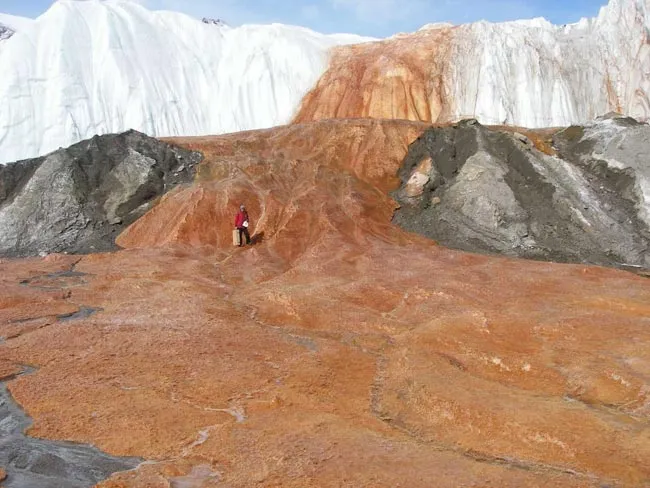
Scientists took water samples from Blood Falls, a curious blood-red waterfall-like feature that sporadically flows from the edge of Taylor Glacier.
Analyses revealed that the glacier water held microorganisms that use sulfur compounds to extract iron in the bedrock below the glacier (this iron also accounts for the rusty hue of the water).
"When I started running the chemical analysis on [the samples], there was no oxygen. That was when this got really interesting, it was a real 'eureka' moment," said researcher Jill Mikucki, who conducted the research, which was supported by the National Science Foundation, while a graduate student at Montana State University and a postdoctoral researcher at Harvard University. She currently works at Dartmouth College in New Hampshire.
The researchers can't drill down to the pool that is home to the microbes because the ice is too thick and too far back from the edge of the glacier, but they think the pool is less than 3 miles (5 kilometers) across and was formed about 1.5 million to 2 million years ago.
Genetic tests suggest that the microbes are similar to ones found in marine environments today, which the researchers think are a remnant of a larger population of microbes that once lived in a fjord or sea that was cut off when sea levels fell and left the pool behind. The pool was eventually capped off by the flowing glacier.
"It's a bit like finding a forest that nobody has seen for 1.5 million years," said study team member Ann Pearson of Harvard. "Intriguingly, the species living there are similar to contemporary organisms, and yet quite different — a result, no doubt, of having lived in such an inhospitable environment for so long."
The water the microbes dwell in averages a temperature of 14 degrees Fahrenheit (minus 10 degrees Celsius), but doesn't freeze because the water is three to four times saltier than the ocean.
This briny pond "is a unique sort of time capsule from a period in Earth's history," Mikucki said. "I don't know of another environment quite like this on Earth."
Learning more about this unique environment could shed light on how microorganisms might survive on icy planets in our solar system, such as below the Martian ice caps or in the ice-covered ocean of Jupiter's moon Europa.
- Video – Under Antarctic Ice
- Antarctica News, Images and Information
- Images: Alien Life of the Antarctic