













Lizard Study Reveals Why Cheetahs Are the World's Fastest Animals

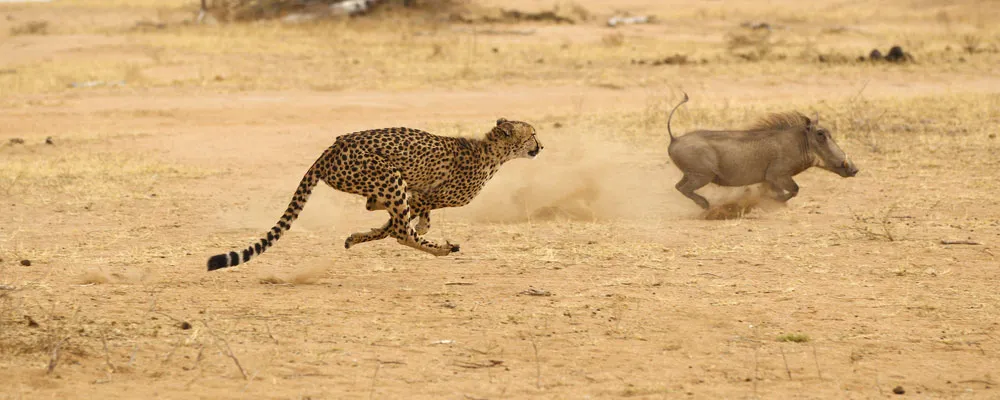
Why are cheetahs the fastest runners on Earth? Physiologists studying lizard locomotion have found that running speed peaks in midsize animals, whose bodies hit a sweet spot of long legs and low body mass. The cheetah is a near-perfect blend of those two attributes.
"Typically, bigger animals tend to run faster than smaller animals, because they have longer legs," said Christofer Clemente of Harvard University's Propulsion Physiology Lab, who led the research. Longer legs allow the animal to cover more ground per stride and hit higher speeds.
"But this only works up to a point," Clemente said. "The fastest land animal is neither the biggest nor the smallest, but something in between. Think about the size of an elephant, a mouse and a cheetah."
Cheetahs accelerate to 70 mph (112 kilometers per hour) while chasing prey.
To chart the relationship between running speed and body size, Clemente and his team studied monitor lizards, which vary substantially in size. (Testing within a single species helped control for other variables, such as evolutionary adaptations that might make one species purposely slower than its body's maximum speed; confining themselves to monitor lizards allowed the researchers to compare running speed and body size directly.)
The researchers timed and photographed lizards ranging from two to 12 pounds as they sprinted along a 45-foot track. The midsize lizards proved fastest.
Using high-speed cameras and markers placed at key points on the lizards' bodies, the researchers generated computer models of each of the reptiles' runs, enabling a comparison of their running strides.
Get the world’s most fascinating discoveries delivered straight to your inbox.
"We then looked at how the mechanics of the stride changed with body size, and we found that the changes in the stride were consistent with the changes in speed," Clemente explained in a press release. "Above a certain size, lizards were changing the way they ran, perhaps due to a decreased ability of the bones and muscles to support a larger body mass."
Larger lizards have longer legs — an advantage when it comes to running speed — but too much size creates biomechanical constraints: "Larger lizards' legs can no longer support their body weight, and they have to change their style of running, making them slower," he said.
The research is detailed in the May/June issue of the journal Physiological and Biochemical Zoology.
