 Live Science Plus





You are now subscribed
Your newsletter sign-up was successful
Want to add more newsletters?

Delivered Daily
Daily Newsletter
Sign up for the latest discoveries, groundbreaking research and fascinating breakthroughs that impact you and the wider world direct to your inbox.

Once a week
Life's Little Mysteries
Feed your curiosity with an exclusive mystery every week, solved with science and delivered direct to your inbox before it's seen anywhere else.

Once a week
How It Works
Sign up to our free science & technology newsletter for your weekly fix of fascinating articles, quick quizzes, amazing images, and more

Delivered daily
Space.com Newsletter
Breaking space news, the latest updates on rocket launches, skywatching events and more!

Once a month
Watch This Space
Sign up to our monthly entertainment newsletter to keep up with all our coverage of the latest sci-fi and space movies, tv shows, games and books.

Once a week
Night Sky This Week
Discover this week's must-see night sky events, moon phases, and stunning astrophotos. Sign up for our skywatching newsletter and explore the universe with us!
Join the club
Get full access to premium articles, exclusive features and a growing list of member rewards.
Instead of just killing off cancer cells directly, chemotherapy works because it prompts the body's own defenses to destroy tumor cells, new research in mice suggests.
The findings, published April 4 in the journal Immunity, suggest the immune system plays a critical role in fighting cancer.
"You need the host immune system — the reaction against the tumor — to work," said study co-author Guido Kroemer, an immunologist at the National Institute of Health and Medical Research in France.
If follow-up studies in people show a similar effect, doctors could boost the immune response to increase chemotherapy's effectiveness or measure a patient's immune response to specific drugs to predict chemotherapy's success, Kroemer told LiveScience.
Killer drugs
Until now, scientists had a limited understanding of how chemotherapy works. They assumed that the treatment worked by selectivelykilling more tumor cells than healthy cells, Kroemer said.
But the immune system also seemed to play a role. For instance, past work showed that chemotherapy required a particular immune cell type — called T-lymphocytes, or T-cells — in order to work against breast cancer.
Immune response
To understand how T-lymphocytes identified tumor cells, Kroemer and his colleagues marked cancer cells in mice with a protein that glowed green. They then watched what happened to those cells after they gave the mice an anthracycline, a specific type of chemotherapy. Anthracyclines are used to treat breast cancer, as well as prostate and lung cancer.
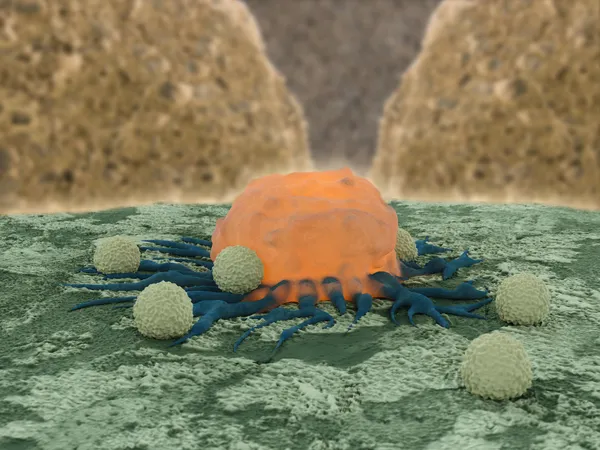
The researchers found that specific immune cells were drawn to a chemical signal from the tumor cells and then presented them to the T-lymphocyte immune cells.
To show that this cell played a key role in chemo's effectiveness, the team showed that mice lacking these presenting molecules had a marked reduction in chemotherapy response.
The research suggests that the immune system may play a wider role in fighting cancer than previously thought, Kroemer said.
Follow Tia Ghose on Twitter @tiaghose. Follow LiveScience @livescience, Facebook & Google+. Original article on LiveScience.com.

