Beneath the surface of museum masterpieces lie the secrets of the art world.
Artists often repainted canvases, either to enhance the colors or shapes of a previous composition, or simply because they couldn't afford to buy a new canvas. Ancient wall frescoes, too, often got refreshed or altered by a building's new owner.
But how could art historians discover the hidden artwork beneath a painting or fresco without damaging the surface?
Latest Videos From
Airport security scanners, which use terahertz radiation to screen passengers and provide whole-body imagery to security personnel, were the answer.
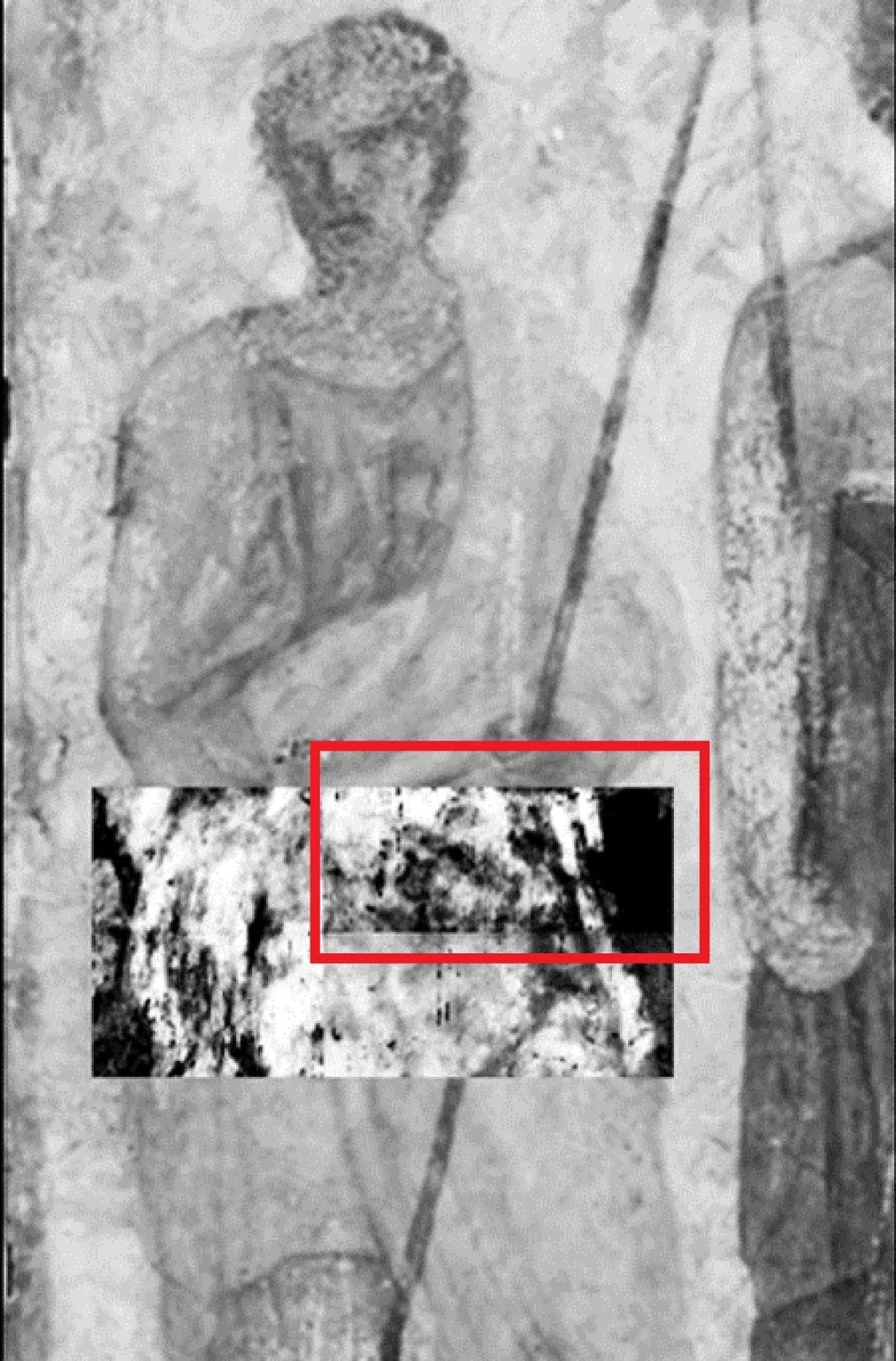
In a first, art historians have used terahertz radiation to reveal an early fresco beneath the surface of "Trois hommes armés de lances" ("Three men armed with lances"), one of the Louvre Museum's fresco treasures. The research was presented Wednesday (April 10) at a meeting of the American Chemical Society in New Orleans.
"We were amazed, and we were delighted," J. Bianca Jackson, an expert in terahertz spectroscopy at the University of Rochester, said in a statement. "We could not believe our eyes as the image materialized on the screen."
The image Jackson and her colleagues saw was the face of an ancient Roman man, hidden for centuries beneath the surface of a later fresco.
"Underneath the top painting of the folds of a man's tunic, we saw an eye, a nose and then a mouth appear," Jackson said. "We were seeing what likely was part of an ancient Roman fresco, thousands of years old."
Art historians and conservators already have an arsenal of technology — X-ray radiography, infrared photography, infrared reflectometry and UV fluorescence — to examine artwork and expose forgeries. X-ray radiography, for example, has revealed a portrait of a woman hidden beneath van Gogh's "Patch of Grass."
And scientists who scanned the "Mona Lisa" with a camera that uses 13 wavelengths of light (from ultraviolet to infrared) discovered Leonardo da Vinci had given his subject eyebrows.
The terahertz spectroscopy scanning device Jackson trained on the Roman fresco has been used in the pharmaceutical industry, in biomedical imaging and, of course, in airport security to see beneath the clothing of airline passengers.
The technology uses beams of radiation that lie between microwaves and infrared radiation on the electromagnetic spectrum. The radiation is relatively weak — too weak to harm ancient artwork. The imaging process is also somewhat slow, requiring a few hours to analyze an area as small as a letter-sized sheet of paper.
Jackson also has used terahertz technology to examine a fresco from the Riga Dom Cathedral in Latvia and a Neolithic site in Çatalhöyük, Turkey, renowned for its spectacular wall paintings.
Follow Marc Lallanilla on Twitter and Google+. Follow us @livescience, Facebook & Google+. Original article on LiveScience.com.