 Live Science Plus



Farthest Star Explosion Yet Revealed by Hubble
You are now subscribed
Your newsletter sign-up was successful
Want to add more newsletters?
Delivered Daily
Daily Newsletter
Sign up for the latest discoveries, groundbreaking research and fascinating breakthroughs that impact you and the wider world direct to your inbox.
Once a week
Life's Little Mysteries
Feed your curiosity with an exclusive mystery every week, solved with science and delivered direct to your inbox before it's seen anywhere else.

Once a week
How It Works
Sign up to our free science & technology newsletter for your weekly fix of fascinating articles, quick quizzes, amazing images, and more
Delivered daily
Space.com Newsletter
Breaking space news, the latest updates on rocket launches, skywatching events and more!
Once a month
Watch This Space
Sign up to our monthly entertainment newsletter to keep up with all our coverage of the latest sci-fi and space movies, tv shows, games and books.
Once a week
Night Sky This Week
Discover this week's must-see night sky events, moon phases, and stunning astrophotos. Sign up for our skywatching newsletter and explore the universe with us!
Join the club
Get full access to premium articles, exclusive features and a growing list of member rewards.
Astronomers have spotted the most distant massive star explosion of its kind, a supernova that could help scientists better understand the nature of the universe.
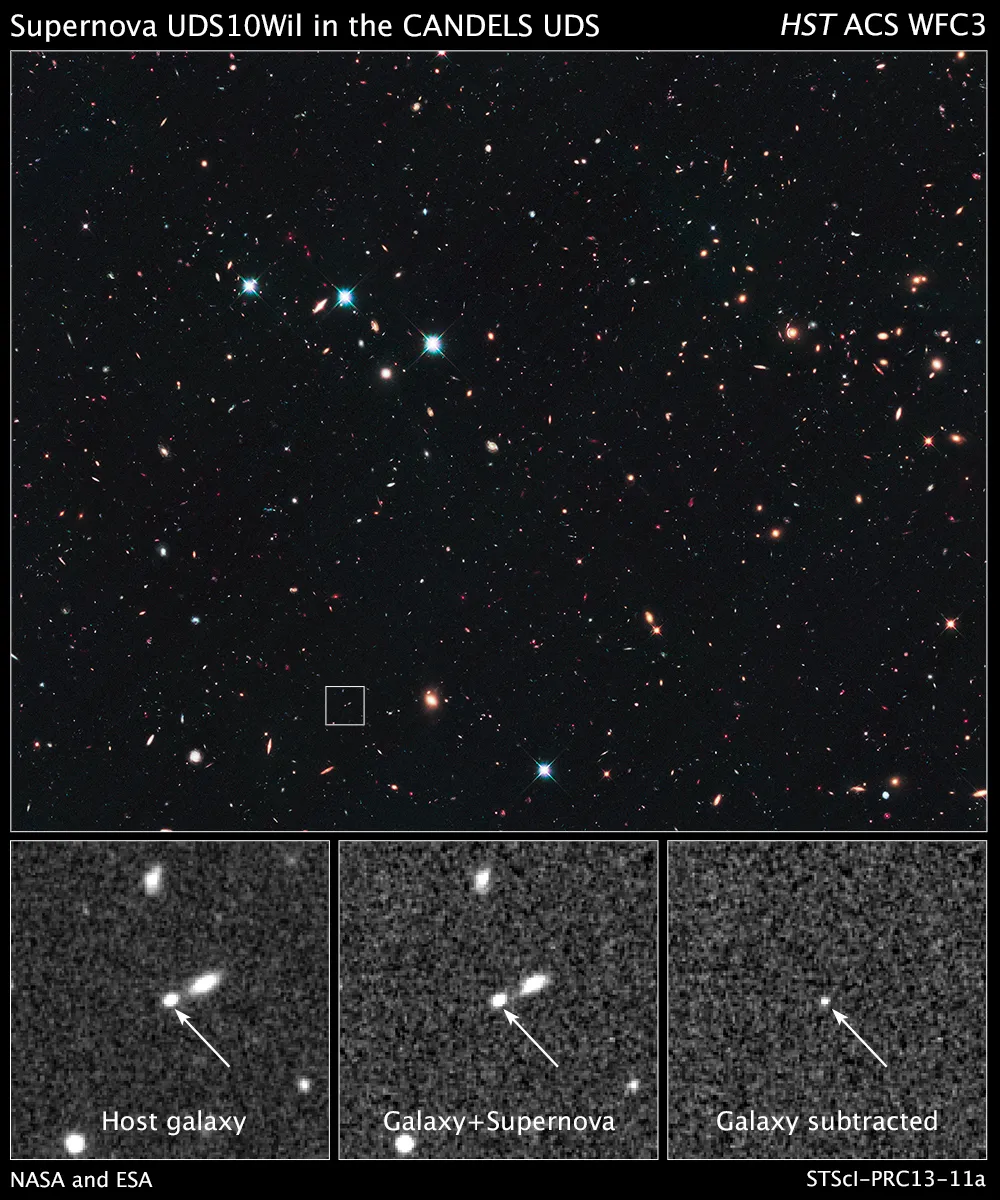
Using the Hubble Space Telescope, scientists recently caught sight of Supernova UDS10Wil (nicknamed SN Wilson) which exploded more than 10 billion years ago. It took more than 10 billion years for the light of this violent star explosion to reach Earth.
SN Wilson is known as a Type Ia supernova — a particular kind of star explosion that gives scientists a sense of how the universe has expanded over time.
"This new distance record holder opens a window into the early universe, offering important new insights into how these stars explode," research leader David Jones of Johns Hopkins University in Baltimore, Md., said in a statement. "We can test theories about how reliable these detonations are for understanding the evolution of the universe and its expansion." [See Amazing Pictures of Supernovas]
SN Wilson is only four percent more distant than the last most distant supernova of its kind found by Hubble, NASA officials said in a statement. However, that is still 350 million years further back in time than any other previously found star explosion.
By understanding when massive stars began exploding, scientists can get a sense of how quickly the universe was seeded with the elements needed to create planets and other cosmic bodies.
"If supernovae were popcorn, the question is how long before they start popping?" Adam Riess, an astronomer at the Space Telescope Science Institute in Baltimore, Md., said in a statement. "You may have different theories about what is going on in the kernel. If you see when the first kernels popped and how often they popped, it tells you something important about the process of popping corn."
This work also might contribute to other work being done on what triggers these massive explosions, a question that has plagued astronomers since the discovery of Type Ia supernovas.
This discovery is also part of a three-year-initiative by the Hubble program to find the most distant supernovas. Scientists with the program hope to understand if the star explosions have changed in some way since the Big Bang birthed the universe 13.8 billion years ago.
The Hubble Space Telescope was launched in 1990. It is expected to continue functioning for the next five years or so, and its successor, the James Webb Space Telescope, is scheduled for launch in 2018.
The new findings will be published in an upcoming issue of "The Astrophysical Journal."
This story was provided by SPACE.com, sister site to Live Science. Follow Miriam Kramer @mirikramer and Google+. Follow us @Spacedotcom, Facebook and Google+. Original article on SPACE.com.

