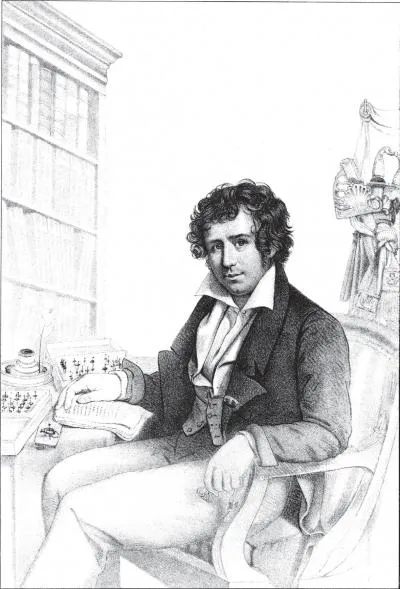
Count Pierre Dejean may have been a general in Napoleon Bonaparte's army, but he was perhaps more intimidating as a beetle collector.
By the time he died in 1845, Dejean had amassed a daunting collection of 24,643 species of beetles and more than 118,000 specimens, some of them scooped up from battlefields. At the time, it was the largest beetle collection ever assembled by one person, researchers say. Scientists have only now updated the catalogues Dejean wrote to describe his impressive collection.
Born in 1780, Dejean developed an early interest in insects, hoarding butterflies and moths (both in the order Lepidoptera) as a boy before graduating to the order of Coleoptera, or beetles, which became his lifelong passion. Dejean's youngest daughter, in the preface of one of her poetry books, recalls an episode of her father's obsession from one of his war stories: "He recounted himself that during the battle he stopped his horse to attach a small insect to his helmet and then carried on forward to combat."
Napoleon's campaigns took Dejean to Spain, Portugal, Italy, Austria, Poland, Germany and Russia, where beetle specimens became his spoils of war. When Napoleon fell in 1815, Dejean (who served as a field assistant to the commander himself at Waterloo) used his exile in the Austrian empire as an opportunity to keep collecting. After he returned to France, he bankrolled collecting expeditions and purchased a number of collections, including that of entomologist Pierre André Latreille, which added 1,700 species to Dejean's collection. [Image Gallery: Shimmering Metallic Beetles]
This is an image of Batocera wallacei Thomson, 1858 from Australasia, which belongs to the genus Batocera Dejean, 1835.
(Image credit: Udo Schmidt)
Over his lifetime, Dejean published four catalogues of the beetles in his collection, including many species that had yet to be formally described by scientists. Taxonomists and collectors often proposed scientific names for new species they found during the 19th century, but specimens were often exchanged, sold or given away before they officially entered scientific literature, researchers say.
To relieve some of confusion around Dejean's specimens, researchers Yves Bousquet and Patrice Bouchard, of the Canadian National Collection of Insects, Arachnids and Nematodes, took a crack at Dejean's catalogues and for the first time provided a detailed nomenclatural summary of all generic names for the general's Coleoptera collection.
"While working on a number of catalogues in the past, it became clear to us that the generic names in Dejean's second and third catalogues had been a source of confusion." Bousquet and Bouchard said in a statement. "While experts of some groups in Coleoptera had consistently applied the rules of nomenclature to deal with these names, genera in other groups were often misused or had been completely ignored.
Sign up for the Live Science daily newsletter now
Get the world’s most fascinating discoveries delivered straight to your inbox.
For beetle buffs eager to peruse the updated catalogue, the journal ZooKeys made it available online this week.
Megan has been writing for Live Science and Space.com since 2012. Her interests range from archaeology to space exploration, and she has a bachelor's degree in English and art history from New York University. Megan spent two years as a reporter on the national desk at NewsCore. She has watched dinosaur auctions, witnessed rocket launches, licked ancient pottery sherds in Cyprus and flown in zero gravity. Follow her on Twitter and Google+.