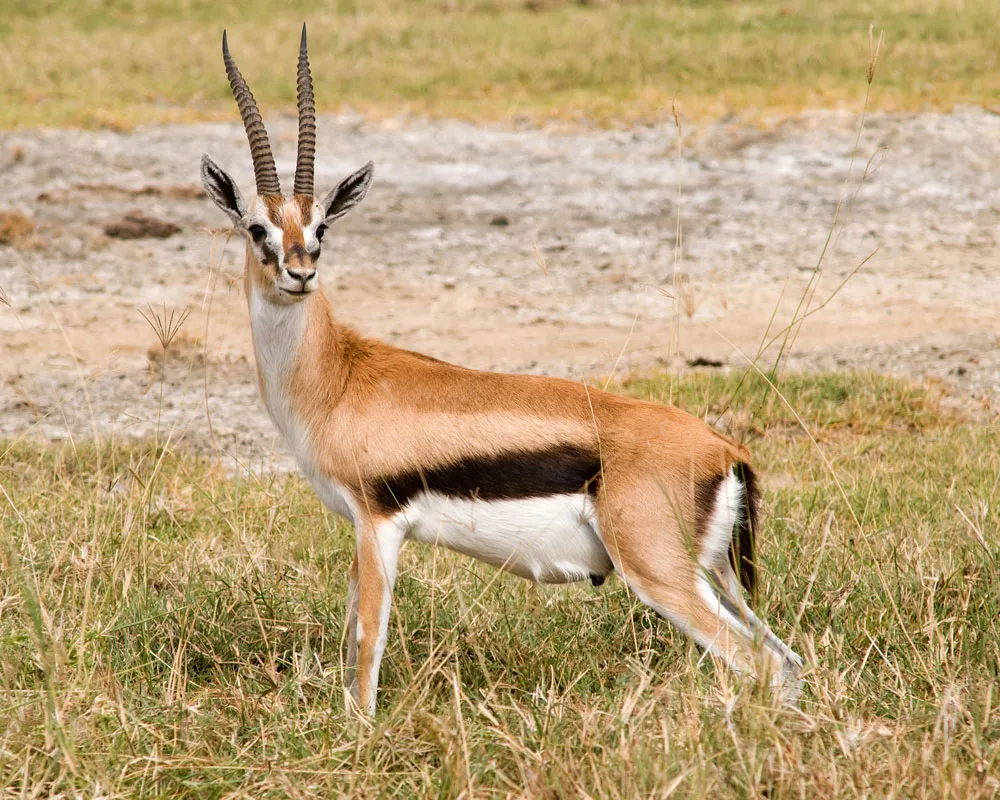
Gazelles are thin, graceful antelopes that live in Africa and Asia. They resemble deer and are in the same family as goats, cattle and sheep. Gazelles can be identified by their curved, ringed horns, tan or reddish-brown coats and white rumps. Often, there are spots or stripes on their coats. Their light frames help make them agile and better able to escape from predators.
There are 19 species of gazelle, according to the Integrated Taxonomic Information System (ITIS). Smaller species, such as the Speke's gazelle and Thomson's gazelle, are only 20 to 43 inches (51 to 109 centimeters) at the shoulder. They weigh from 26 to 165 pounds (12 to 75 kilograms). The dama gazelle is the largest gazelle. It weighs in at 88 to 165 pounds (40 to 75 kg) and is 4.5 to 5.5 feet tall (137 to 168 cm).
Habitat
Most gazelles live in the hot, dry savannas and deserts of Africa and Asia. To stay hydrated in these grueling environments, gazelles shrink their heart and liver, according to a study published in the journal Physiological and Biochemical Zoology. Breathing can cause an animal to lose a lot of water. A smaller heart and liver need less oxygen, so the animal can breathe less and lose less water.
The Edmi gazelle, also known as the Cuvier's gazelle,is the only gazelle that lives in the mountains. It migrates during the wintertime to warmer regions.
Habits
Gazelles rely on their speed to escape from predators. Gazelles can reach speeds up to 60 mph in short bursts and sustain speeds of 30 to 40 mph. When running, gazelles use a bounding leap, called "pronking" or "stotting," which involves stiffly springing into the air with all four feet.
These animals are highly social. Some gazelle herds have as many as 700 members, though some herds are small and segregated by gender. Female Thomson's gazelles, for example, live in herds of 10 to 30 females in addition to their young. Males live alone or in small groups with other males. A male herd is called a bachelor's herd. The segregation of herds is more prominent during mating season.

Offspring
Mating season is usually timed to occur during the rainy season so that the newborn fawns will have plenty to drink.
Gazelles carry their young for around six months before giving birth. They have one to two young at a time. Baby gazelles are called fawns or calves.
To keep her calves safe from predators, a female gazelle will hide her babies in tall grasses. While the young are still nursing, they stay with their mother's herd. When they are ready to fend for themselves, male calves are moved to the male herd. Gazelles typically live 10 to 12 years.
Diet
Gazelles are herbivores. This means they only eat vegetation, typically grasses, leaves and shoots of plants. According to "Endangered Wildlife and Plants of the World, Volume 5" (Marshall Cavendish Corp., 2001) some gazelles can live their entire lives and never drink any water.
Classification/taxonomy
The taxonomy of gazelles, according to ITIS, is:
- Kingdom: Animalia
- Phylum: Chordata
- Subphylum: Vertebrata
- Class: Mammalia
- Order: Artiodactyla
- Family: Bovidae
- Genus: Gazella
- Species: 19, including G. thomsonii (Thomson's gazelle), G. spekei (Speke's gazelle), G. dorcas (Dorcas gazelle) and G. dama (dama gazelle).
There are many vulnerable and endangered species of gazelle. For example, the Cuvier's gazelle's population is estimated at only 1,750 to 2,950, according to International Union for Conservation of Nature's Red List. Another endangered species is the slender-horned gazelle. It is estimated that there are only a few thousand left.
Conservation status
The dama gazelle is not only the world's biggest gazelle, it is also the rarest, according to the Smithsonian National Zoological Park. It is critically endangered and has a population of less than 500.
The major threat facing gazelles is hunting. The Queen of Sheba's gazelle became extinct when it was hunted for food in 1951 by soldiers, according to the IUCN.

Other facts
The name gazelle comes from the Arabic "gazal," the term for love poems.
A gazelle will flick its tails or stomp its feet to warn others of a lurking predator.
The horns of the Edmi gazelle can grow to 14 inches (35.5 centimeters) long.
Goitered gazelles get their name from the large bump on their throats. The bump is larger on males. It is a large patch of cartilage that helps them bellow loudly to potential mates during mating season.
Gazelles can stand on their back legs to reach leaves high in the branches of trees.
Other resources:

