It's quick and easy to access Live Science Plus, simply enter your email below. We'll send you a confirmation and sign you up for our daily newsletter, keeping you up to date with the latest science news.
At the edge of the solar system is a violent frontier where two cosmic powers clash. On one side is the solar wind, the constant flood of hot, charged particles flowing out of the sun at hundreds of miles per second. On the other side are the winds of space, blowing with the radiation of billions upon billions of nearby stars.
Despite causing occasional blackouts here on Earth, the solar wind actually does a pretty good job of defending our planet (and the solar system) from the harshest interstellar radiation. As the wind gusts out of the sun in every direction at once, it forms an enormous protective bubble around the solar system that repels about 70% of incoming radiation, Live Science previously reported. (Earth’s magnetic shield protects us from much of the rest).
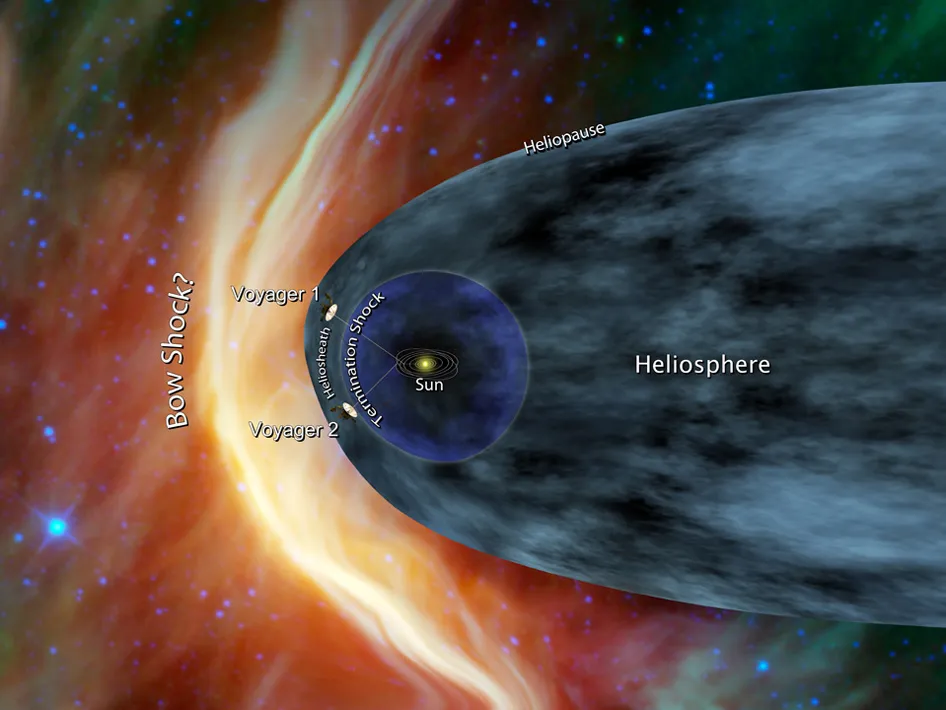
This bubble is known as the heliosphere, and its edge (called the heliopause) marks a physical border where the solar system ends and interstellar space begins — but, unlike most borders on Earth, scientists have no idea how big it is or what it looks like. A new study, published June 10 in The Astrophysical Journal, tackles these mysteries with the first 3D map of the heliosphere ever created.
Using 10 years of data captured by NASA's Interstellar Boundary Explorer satellite, the study authors tracked solar-wind particles as they traveled from the sun to the edge of the solar system and back again. From this travel time, the team calculated how far the wind had blown in a given direction before being repelled by interstellar radiation, allowing the researchers to map the invisible edges of the solar system similarly to the way bats use echolocation, the researchers said.
The team's three-dimensional map of the heliosphere shows the bubble is far thinner on the side facing the interstellar wind than on the opposite side.
(Image credit: Reisenfeld et al)
"Just as bats send out sonar pulses in every direction and use the return signal to create a mental map of their surroundings, we used the sun's solar wind, which goes out in all directions, to create a map of the heliosphere," lead study author Dan Reisenfeld, a scientist at Los Alamos National Laboratory in New Mexico, said in a statement.
As the team's map shows, the heliosphere doesn't exactly stay true to the "sphere" part of its name; the barrier around the solar system is more of a wibbly-wobbly blob that's far thinner on one side than on the other.
That's because, just as our planet orbits the sun in a set direction, the sun orbits the center of the Milky Way, pushing headlong against the interstellar wind that crosses the sun's path. In this windward direction, the distance from the sun to the edge of the heliosphere is considerably shorter than it is in the opposite direction — about 120 astronomical units (AU), or 120 times the average distance from Earth to the sun, facing the wind versus at least 350 AU in the opposite direction.
Sign up for the Live Science daily newsletter now
Get the world’s most fascinating discoveries delivered straight to your inbox.
Why "at least" that amount? Because 350 AU is the distance limit of the team's wind-mapping method; the heliosphere could potentially extend much further behind the solar system than it appears on the team's map, meaning the protective bubble could be even blobbier than it seems here. Like bats in a cave, we'll have to fly even deeper into the darkness to figure that out.
Brandon is the space / physics editor at Live Science. With more than 20 years of editorial experience, his writing has appeared in The Washington Post, Reader's Digest, CBS.com, the Richard Dawkins Foundation website and other outlets. He holds a bachelor's degree in creative writing from the University of Arizona, with minors in journalism and media arts. His interests include black holes, asteroids and comets, and the search for extraterrestrial life.

 Live Science Plus