













New Earth-Sun Distance Decided by Vote

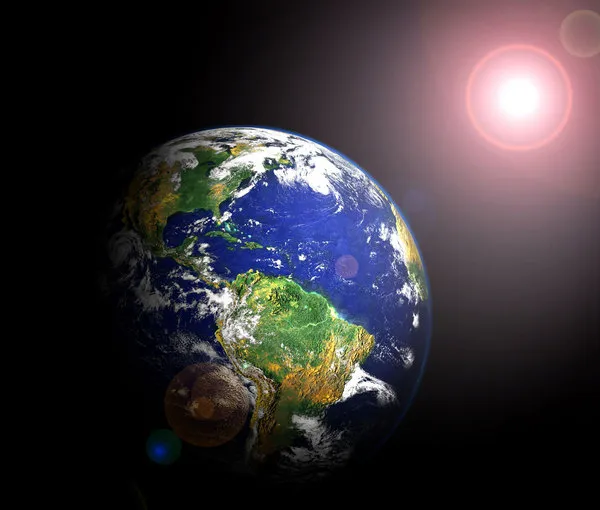
In a solar-system-shaking victory for lay language, scientists have voted to redefine one of the most foundational measurements in all of astronomy, the mean distance between the sun and the Earth.
Next time a 5-year-old asks you how far the sun is, know you have the unanimous support of the International Astronomical Union (IAU) in answering clearly and confidently: 149,597,870,700 meters (about 92,955,807 miles).
The IAU voted in August to change the definition of the distance, called the astronomical unit (AU), to a plain old number. Before that, the unit had been defined by a roundabout equation that was bad for precise calculations and layman comprehension alike.
According to the news site of the journal Nature, the distance was said to be "the radius of an unperturbed circular Newtonian orbit about the sun of a particle having infinitesimal mass, moving with a mean motion of 0.01720209895 radians per day (known as the Gaussian constant)."
Along with making things unnecessarily difficult for astronomy professors, that definition actually didn't jibe with general relativity. Using the old definition, the value of AU would change depending on an observer's location in the solar system. If an observer on Jupiter used the old definition to calculate the distance between the Earth and the sun, the measurement would vary from one made on Earth by about 1,000 meters (3,280 feet).
Moreover, the Gaussian constant depends on the mass of the sun, and because the sun loses mass as it radiates energy, the value of AU was changing along with it.
Astronomers hadn't come up with the more abstruse and indirect definition just for their own amusement. Before the advent of spacecraft and radar, there was no method for making a direct measure of the distance between the Earth and the sun.
Get the world’s most fascinating discoveries delivered straight to your inbox.
The Earth orbits the sun in an ellipse, and its distance from the sun varies from about 147 billion meters (91 million miles) to about 152 billion meters (94.5 million miles).
Follow Life's Little Mysteries on Twitter @llmysteries. We're also on Facebook & Google+.
